Barley to Brie: Inside the Circular Economy of Whisky and Cheese
- Featured Spirits
 Payel Majumdar Upreti
- 17 minutes read

What happens to the grains that produce the delicious dram in our glass? It is rare to spare a thought on grain while enjoying a sip of the golden liquid; however, whisky is very much an agricultural product, affected by the vagaries of climate like anyone else. The industry is increasingly looking at more sustainable practices to reduce its carbon footprint, beyond the most obvious ways. The Scottish Whisky Association has set a target to achieve net-zero emissions in the industry by 2040.
The primary grains used in the whisky industry include barley, rye, corn and wheat. Spent grain, commonly known as ‘draff’ in the whisky industry is a significant by-product generated during whisky production. While it is mostly thrown away, there have been several moves in current times to relook at this nutrient-rich material which has several different applications to extend its live and make whisky production’s circularity complete.
Just take a look at the numbers: For every litre of whisky produced, approximately 2.5-3 kg is spent grain is generated. Till now, a portion of spent grain is repurposed as animal feed due to its high protein and fibre content. In Scotland, about 74 percent of distillery by-products including spent grain is utilised in animal feeds as per a study by the Scottish government.
However, is there a way to monetise and add value beyond using spent grain as animal feed or compost? That’s where people like Elizabeth Yorke, Founder of Saving Grains comes in. “Historically, brewers and bakers worked closely, with spent grains used in breads.. At Saving Grains, we drew inspiration from this age-old practice and the circular economy movement to reimagine spent grains for modern food products — from granola and crackers, laddoo’s, chapati and cookies and even as a medium for aging cheese. It’s about recognising that the value of an ingredient doesn’t end at the first use.”
Food from draff
Breads and pastas from whisky isn’t knew as Yorke mentions earlier. There’s a lot of potential in by-product upcycling across the food and beverage space. Beyond brewers’ spent grain, there’s distillers’ spent yeast, citrus peels and botanicals from gin and cocktail programmes, coffee grounds from cafés, and even whey from cheesemaking — which interestingly can also be distilled into spirits. These ingredients still hold incredible flavour and function and deserve a second life, according to Yorke. “The circular economy isn’t a one-person initiative. Through Saving Grains, we want to set an example with spent grain to show what’s possible — and open the doors for more people to join this space, experiment, and build collaborative, delicious solutions together.”

Says Namrata Sundaresan, Chennai-based social entrepreneur and cheesemaker, Founder of Käse Cheese, who was introduced to spent grains by Yorke, “I had no prior background of spent grains, I was introduced to it by Elizabeth. I had a specific cheese in mind for which I was looking for hay (to age cheese on a bed of hay). I decided to use the spent grains instead. However, as I started working with them I realized that there was so much more to it. They were edible and had proteins and enzymes which were also being broken down by the same microbes that were present in the cheese!”
Nutrition and taste
There are several nutritional benefits of using spent grain in baked goods. Spent grain is naturally high in fibre (about 40–45%) and protein (20–25%), making it a nutritious addition to everyday foods. It also has a wonderful malty and nutty flavour that adds depth and texture to baked goods, granola, crackers, and even savoury dishes. From a culinary perspective, it’s incredibly versatile — working well in both sweet and savoury formats. Plus, incorporating spent grain allows us to create higher fibre, lower carb alternatives to conventional products while reducing food waste. It’s health-forward, flavour-rich, and climate-smart all at once. Says Yorke, “We currently work with microbreweries to upcycle brewers’ spent grain. Since it’s a highly perishable by-product, we have a process in place to pick up the grain in a food-safe manner within hours of it being produced. From there, we immediately process and dry the grain to stabilise it and extend its shelf life. This ensures it retains its flavour and nutritional value while becoming a versatile ingredient we can use year-round.”
When it comes to cheese, spent grains contribute a nutty, malty, and slightly sweet flavor to cheese. The specific grain used (e.g., barley, wheat) and the roasting level during brewing can add subtle variations, such as toasty, biscuity, or caramel notes which follows through in its by-product cheese as well. Says Sundaresan, “These flavors complement cheeses like cheddar, gouda, or alpine-style varieties, enhancing their complexity. These qualities also depend on the grain type, brewing process, and how finely the grains are milled or blended into the cheese. For example, lighter beers leave milder, sweeter grains, while darker brews yield more robust, roasted flavors.”
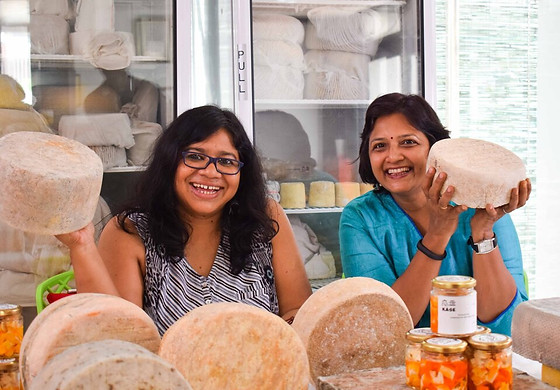
The grains introduce a gritty or slightly chewy texture, depending on their size and incorporation method. In semi-soft or hard cheeses, they can create a speckled appearance and a subtle crunch, adding contrast to the creaminess. Proper integration is key to avoid an overly grainy mouthfeel.
Spent grains boost the nutritional value of cheese by adding dietary fiber, which is typically low in dairy products. They also provide small amounts of protein, B vitamins, and minerals like magnesium and phosphorus. While not a significant source of these nutrients, they enhance the overall nutrient density compared to plain cheese. Agrees Sundaresan, “Increased dietary fiber, protein and overall a nutrient dense food. The unique, nutty, malty, toasty flavours help and they can be used in various culinary applications, cheese and baked goods.”
Mapping the impact
Elizabeth Yorke believes there is a huge impact to be achieved from processing spent grains in climate smart ways. She says, “It’s incredibly significant because spent grain is the largest by-product of the brewing and distilling process — making up nearly 85% of total production waste by volume. In a city like Bengaluru alone, craft breweries generate around 12,000 kgs of spent grain daily. By repurposing even a fraction of this into edible, high-value products, we can meaningfully reduce what would otherwise go to waste or low-value uses like compost or feed. It’s a tangible way for the industry to close the loop, meet sustainability goals, and create new value streams — proving that circularity isn’t just a nice idea, but a practical, flavorful business model.”
By encouraging a potential target audience to try out these upcycled products, it can have a wider impact. Says Yorke, “Awareness is growing, but it’s still a work in progress. Many consumers are unfamiliar with terms like spent grain or by-product upcycling, so we focus on storytelling through our packaging, social media, events, and workshops — explaining where the ingredient comes from, how it’s processed, and why it matters.” Highlighting the nutrition and flavour benefits up front is key as leading with taste and value helps shift perceptions. It’s less about selling ‘waste’ and more about showing how good food can come from unexpected places. And the more people experience it, the more curiosity and conversation it sparks — which is exactly what the duo are hoping to build.
Systemic challenges
One of the biggest challenges is logistics, by-products like spent grain are highly perishable and need to be processed within hours of production. Coordinating timely pick-ups from breweries, ensuring food-safe handling, and finding consistent, small-scale processing infrastructure in urban areas has been tricky. Another hurdle is perception.
Many people still view by-products as waste, so shifting mindsets — both in the industry and among consumers — takes time and storytelling. And of course, financial viability at a small scale is a constant challenge without large industrial infrastructure.
Scaling the process globally poses risks if not aligned with circular economy principles. A linear ‘take-make-waste’ approach, driven by efficiency, overlooks the environmental cost of by-products. In contrast, a circular economy model considers waste as a resource, building resilience and adaptability. Scaling without this foresight risks replicating traditional practices that exacerbate waste and environmental harm. Says Yorke, “By thoughtfully integrating by-product management and flexible systems, Saving Grains can create a sustainable model that benefits both people and the planet, while mitigating the limitations of linear economies.”

It’s also about learning from other industries and each other adds Sundaresan. “Just like with spent grain, we’ve explored its potential across various sectors, moving from brewing to baking to cheese-making, extracting value in multiple forms.” Brewers’ spent grain, for instance, can even be used as an innovative packaging material. Cross-sector collaborations facilitate the sharing of resources and ideas, driving creative solutions that not only benefit the environment but also promote sustainable practices across industries.
Says Yorke, “The circular economy isn’t a one-person initiative. Through Saving Grains, we want to set an example with spent grain to show what’s possible — and open the doors for more people to join this space, experiment, and build collaborative, delicious solutions together.”
By redirecting nutrient-rich spent grain from breweries into value-added food products, food waste is actively prevented – one of the largest contributors to greenhouse gas emissions. Says Yorke, “Every kilo of spent grain upcycled reduces the environmental impact of landfill emissions and cuts down the need for additional agricultural resources.” Crucially, it means we don’t need to grow more wheat or barley to make products like granola, crackers, or flour blends — we’re making better use of what’s already been harvested. “Beyond reducing waste, this initiative creates decentralised, community-led food systems that prioritise climate-resilient ingredients, zero-waste practices, and livelihoods, contributing meaningfully to broader sustainability and circular economy goals.”