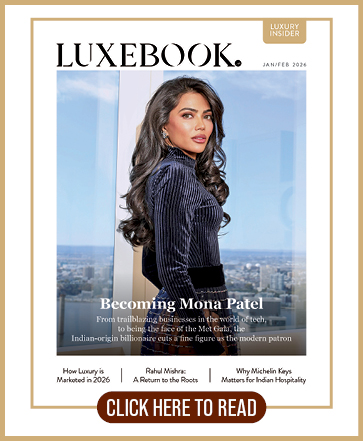
Beyond Tech Empires: The Making of Mona Patel
- Fashion Featured
 Payel Majumdar Upreti
- 11 minutes read

Mona Patel is not just any woman in tech. Educated at Harvard, Stanford, and MIT, the Indian born billionaire brings a rare multidisciplinary lens to everything she touches—from tech ventures to philanthropic initiatives. Her work sits at the intersection of innovation and inclusion, with a sharp focus on gender equity and economic empowerment. But Mona’s most enduring philosophy isn’t just about building companies—it’s about building character. She believes growth is a lifelong pursuit, that learning doesn’t end with a degree or a title, and that reinvention is both a strategy and a state of mind. A regular voice on global stages including the World Economic Forum at Davos, Mona speaks to the future of leadership, the power of entrepreneurship, and the systems we must reimagine to create more equitable outcomes. Outside the boardroom, she is a passionate collector of haute couture—a personal archive that reflects her reverence for craftsmanship, cultural storytelling, and the artistry of legacy. Through her foundation, Couture for Cause, she channels this passion into purpose, funding initiatives that support girls’ education and women’s entrepreneurship across the globe.

While few of Patel’s ventures are associated with luxury, being a largely tech entrepreneur, her sartorial choices and presence at public events at the Met Gala has made her an important figure in the couture world. Says Patel, “I follow creative excellence — designers, artisans, architects and makers — and trace their work wherever it leads. That instinct has taken me from ateliers in the Netherlands to stone-cutting workshops in Jaipur, textile studios in Vietnam, and craft schools in Japan. When you build relationships with creators rather than logos, presence becomes organic, not engineered.” For her, luxury lives in the details: the hand of the maker, the materials chosen with intention, the hours spent labouring over a single decision. “It’s about storytelling, lineage and the relentless pursuit of excellence. If that happens to break the algorithm, so be it.”
Her work operates at the intersection of global cultures. When asked how she ensures cultural references remain authentic rather than ornamental, she states how her appearances are after careful thought to remain intentional. “I’m a lifelong student; I still take university courses. If an exhibition captures my imagination, you’ll often see its influence resurface in how I dress or in what I build next. I grew up between continents, so plurality feels natural to me. My home libraries have always been filled with magazines, auction catalogues, textile histories, and museum monographs — not as decoration, but as study. My looks — and my projects — are simply extensions of what I’m studying or deeply curious about at any given moment. Before I reference a craft or motif, I want to understand who carried it, who taught it, and who preserved it when it was no longer fashionable. If I can’t trace the lineage or the history, I probably won’t borrow it.”

She continues, “Fashion, for me, is where art, architecture, and movement collide through self-expression. That collision — that tension — is where the magic lies.”
Fashion, then is not merely the garment or aesthetic for her and explains her intellectual curiosity in the field as a patron of couture and design, “I approach couture the same way I build companies — with curiosity, collaboration, and obsession. Every piece is a conversation with designers, engineers, tailors, and artists. What appears effortless on a red carpet is often months of shared problem-solving behind the scenes. Authorship is where luxury becomes meaningful — because something exists that would not have otherwise. Fashion is how we show up in the world: not simply dressed, but with a point of view.”
In an industry with constant churn, she believes that relevance is immediate, but legacy is cumulative. In an era obsessed with “newness,” she looks for that legacy, “I’ve spent time in archive rooms in Florence, Mumbai, and Paris — spaces where garments are preserved not because they were popular, but because they were ‘right’.” Endurance and evolution have to go hand-in-hand. Brands and individuals who last aren’t chasing culture; they’re contributing chapters to it — slowly, consistently, with conviction. They are responding to the stimuli.”
The billionaire who once lived in Vadodara, a city known for its deep association with art and design says, “I look for the story embedded in the object — the journey of material, hand, and decision. Once you’ve watched a stone-cutter shape a gem for hours, or seen an atelier adjust a seam three times before approving it, you never unsee that labour. True craftsmanship leaves traces of humanity: small irregularities, intuitive corrections, quiet problem-solving. Insiders recognize when something could not have been rushed. That patience is excellence.”
In this context, she feels Indian representation matters more now than ever. India has always been central to the history of luxury — textiles, gemstones, architecture, embroidery but too often as invisible labour rather than visible authorship. “For centuries, Indian craftsmanship perfected the world’s most celebrated couture, yet remained confined to the supply chain outside the spotlight. Yet, from the Oscars to the Met Gala, almost all of the world’s most celebrated gowns have quietly passed through Indian ateliers.” She cites the example of Marsil Exports, an embroidery house whose work underpins countless couture and red-carpet moments — often unseen, rarely credited, yet foundational. As Indian designers enter the haute couture calendar in their own right, she is proud of the fact that we’re moving from workshop to worldview. “Today, Indian creators, collectors, and patrons are shaping global taste directly — not just supplying skill behind European maisons, but defining aesthetic and narrative themselves. This recognition is long overdue.” The very presence of Indian designers like Rahul Mishra and Gaurav Gupta on the haute couture calendar is a powerful signal of that shift.
Today’s patrons are investors, collaborators and custodians — where does she place herself? I ask her. “All three roles exist, but custodianship matters most to me. I sit on boards, fund initiatives, and build ventures not to own culture, but to protect ecosystems where creativity can remain uncompromised. Modern patronage isn’t about directing artists; it’s about ensuring they never have to dilute their vision to survive.”

She brings to the forefront the essence of a luxury brand’s feel and experience, in her words, “Intimacy is emotional, not transactional. Whether it’s a couture fitting, a philanthropic salon, or a private client experience, people want to feel held — not processed. Scale doesn’t have to erase intimacy, but it won’t preserve it by accident either. You have to architect both deliberately.” Without that intention, growth inevitably dilutes what made the experience meaningful in the first place.
Do boardrooms require her to dress down? Absolutely not, she decries. Early in her career, she felt pressure to conform to a narrow definition of authority — to mute femininity, downplay her interest in fashion, and adopt a more traditionally masculine posture to be taken seriously. “Over time, I realized that approach was both unnecessary and limiting. Fashion taught me that rigor and beauty are not opposites.”
Precision, intuition, and emotional intelligence are strengths, not indulgences in 2026. “I’ve learned to lead without separating who I am from how I work — to be both exacting and expressive, strategic and deeply aesthetic. Traditionally feminine qualities are not at odds with excellent leadership, whether in fashion or in technology. Intuition, for example, isn’t the opposite of data — it’s the compass that helps determine which questions are worth asking.”
As one of my professors at Harvard Business School, Linda Hill, often said: be data-informed, not data-driven. Data guides, but it doesn’t decide. The final judgment still requires human insight and emotional intelligence.
Beyond objects and experiences, how does she curate time — both personally and professionally? “I live a surprisingly offline life. I don’t watch television. I don’t have a Netflix account. I spend most of my time learning, creating, or building – analog style,” says Patel. “My ratio of education to entertainment is very skewed. Time is my most protected asset, and the one I’m most intentional about.”
True tastemakers operate ahead of culture as well as quietly alongside it, according to her. “Both — but timing matters. There are moments to forecast and moments to listen: to artists, to youth, to history. Taste is formed in that balance.”
She doesn’t claim to speak for those born into luxury, “I didn’t inherit access, capital, or a trust fund — I built my life and career first, and luxury entered much later. I always joke that couture is my earned hobby. Because of that, I’m careful not to speak on behalf of people who arrived through entirely different circumstances.” She feels that if brands want to understand the next generation, the most important thing to unlearn is assumption. “Each generation — and each individual — defines their relationship with luxury differently. Instead of prescribing identity or aspiration, they should ask questions and listen.”
Privacy
Privacy is the ultimate luxury. The ability to choose when — and how — to be accessible preserves not just sanity, but clarity. I’m intentional about what I share and what I keep. That agency is a privilege I value deeply. When asked how she wishes her work is viewed decades from now, she says she wants to be remembered for pivoting the conversation around fashion and couture from possession to curation, orchestration, and ecosystem-building, “… that I helped create spaces where collective genius could flourish. And that I celebrated and protected craftsmanship, culture, and imagination quietly enough that the work spoke louder than the name.” And isn’t that the beauty of art anyway, to draw one towards the bigger picture? Mona surely thinks so.
Read LuxeBook Jan-Feb issue here.