Inside Delhi’s next-gen luxury residences
- Featured Retail
 Yashita Damani
- 17 minutes read

In a city where air has become currency, luxury has quietly rewritten its own definition, personified to have lungs. In Delhi, the most coveted residences are no longer being sold on scale alone. Double height ceilings and imported stone still matter, but they are no longer the headline. The new aspiration is subtler and infinitely more intelligent. It is about how a home performs. How it adapts. How it protects you and breathes, basically how it restores. Square footage has ceded power to sensory impact, welcome to the era of rooms without labels.
For decades, Indian homes operated within rigid spatial hierarchies. The drawing room was formal and preserved. The living room was relaxed but contained. The dining room was ceremonial. Guest bedrooms were often untouched sanctuaries waiting for visitors. Each space had a defined identity and an unspoken code of conduct. That choreography is dissolving.

Luxury Under Pressure

Today’s luxury apartment in Mumbai or Delhi feels fluid. The living room flows into a conversational lounge where curved seating replaces stiff symmetry. Dining tables host morning calls before transforming into candlelit dinner stages by night. Guest suites double as wellness rooms complete with blackout drapery, sculptural lounge chairs and discreet aromatherapy systems. Children’s rooms are layered with adaptable joinery that allows play zones to mature into study corners without architectural upheaval.
Flexibility is no longer an afterthought, it is the brief. Developers are responding with projects that position homes as lifestyle ecosystems rather than static containers. Central Park, through its Orchard residences, reflects this shift toward use case driven luxury. Here, the narrative is not about how large the home is but about how intelligently it functions. The emphasis is on intuitive layouts, layered amenities and experiential design that responds to modern living patterns.
The AQI factor
In a post pandemic world shaped by hybrid work and heightened health awareness, the home is expected to perform multiple roles seamlessly. It must host, heal, inspire and insulate. It must expand and contract without feeling compromised. It must support both solitude and social energy. And in Delhi, it must protect.
Air quality has become a defining architectural parameter. Premium societies are integrating centralised purification systems, HEPA filtered HVAC networks and treated fresh air circulation as core infrastructure rather than optional upgrades. Smart dashboards display indoor air metrics with the same pride once reserved for Italian marble specifications. Balconies are curated with dense planting strategies that act as particulate buffers. Glazing systems are engineered for acoustic and environmental insulation.
The result is the rise of the indoor micro environment. Luxury residences are positioning themselves as controlled sanctuaries where climate, air and acoustics are calibrated with precision. The outside world may be chaotic, but inside, where homebodies spend most of their time; the atmosphere is curated.
“The design of luxury real estate in Delhi NCR has become more adaptable. Buyers are looking for homes with improved air quality, adaptable space, and the same level of comfort as a five-star hotel within their home. We have experienced a growing demand from our customers at Central Park for homes designed as entire lifestyle ecosystems, which can successfully integrate wellness, work, and social lifestyle. In addition, the premium housing of the future will be less focused on the size of the home and more focused on how a home improves the daily life of its owners.” says Mr. Ankush Kaul, President – Sales, Marketing & CRM, Central Park
This recalibration extends beyond infrastructure into spatial philosophy.

Architects are increasingly designing homes without fixed boundaries. Movable partitions glide quietly to transform open plans into intimate settings. Fluted glass panels introduce privacy while maintaining luminosity. Modular furniture systems allow rooms to reconfigure without renovation. Rugs, ceiling details and material transitions create tactile zoning that defines space without erecting walls.
The Indoor Retreat: Inspired by Hotels

This sensibility is deeply influenced by global hospitality. Properties such as Aman New York and wellness led resorts like Six Senses have long understood that atmosphere transcends ornamentation. Acoustic insulation, circadian lighting, tactile finishes and scent programming are not aesthetic indulgences but experiential essentials. Indian homeowners are translating these codes into private residences.
The Suite Standard at Home
Bedroom lounges echo presidential suites. In room soaking tubs become sculptural centrepieces. Storage is concealed with butler precision. Bathrooms are calibrated with spa logic rather than utilitarian efficiency. Materials are selected for how they feel against the skin as much as how they photograph. The aspiration is no longer to travel for restoration. It is to live within it.
The rise of multi generational luxury homes further amplifies this shift. Joint family living, once defined by clearly segregated rooms, is now being reimagined through fluid planning. Grandparents, parents and children occupy shared lounge zones without rigid hierarchy. Kitchens spill organically into social spaces. Corridors become art galleries. Transitional areas are activated rather than ignored.
Design is responding to behaviour instead of dictating it since a home must anticipate need. It must soften noise, modulate light, filter air and offer tactile comfort. It must create environments that restore depleted urban lives.
Stone is warmer. Wood is brushed rather than polished, lime plaster walls hold extra texture and depth. Soundproofing is effective and ‘temperature zoning’ allows personalised comfort within shared homes. These are invisible luxuries. And they are far more sophisticated than spectacle.

In Delhi’s evolving real estate landscape, the most discerning buyers are asking different questions. How breathable is the air inside. How adaptable is the layout? Can this space shift effortlessly between work and leisure? Does the lighting support circadian rhythm? Can privacy be achieved without isolation? These questions signal a generational shift.
Rooms without labels are not a design trend. They are a cultural response to how we live now. They acknowledge that life is fluid, that work invades domestic space, that wellness is non negotiable and that atmosphere shapes emotion.
In a city negotiating pollution, density and digital overload, perhaps the ultimate indulgence is a home that understands its inhabitants without needing to be instructed.
The Television Is No Longer the Hero
For decades, the living room was organised around a singular axis: the screen. Furniture aligned obediently. Sightlines converged. The television dictated hierarchy, posture, even conversation. That hierarchy is dissolving.
Designers across studios describe a conscious recalibration of the room’s centre of gravity. Ankit Jain of AE Living speaks about creating “conversation islands” : inward-facing seating clusters defined by rugs, ceiling articulation, and lighting rather than electronics. The television, when present, recedes. It is integrated into darker joinery, concealed behind sliding panels, or positioned off-axis so it no longer commands entry views.
Shivani Gupta Mittal of House of Lalittya approaches planning by first asking how the family actually gathers. Sofas are angled toward each other, distances tightened to encourage natural dialogue. The screen becomes secondary; available, but not sovereign.

Natasha Jain of Bent Collective articulates the shift most succinctly: “When you walk in, your instinct should be to sit and talk, not search for the remote.” -Natasha Jain, Bent Collective.
The living room is being reclaimed as a space for presence rather than passive consumption. Eye contact replaces screen alignment. Acoustics are considered as carefully as aesthetics. Lighting is layered to create intimacy rather than glare.
The Rise of Curves and Sculptural Seating
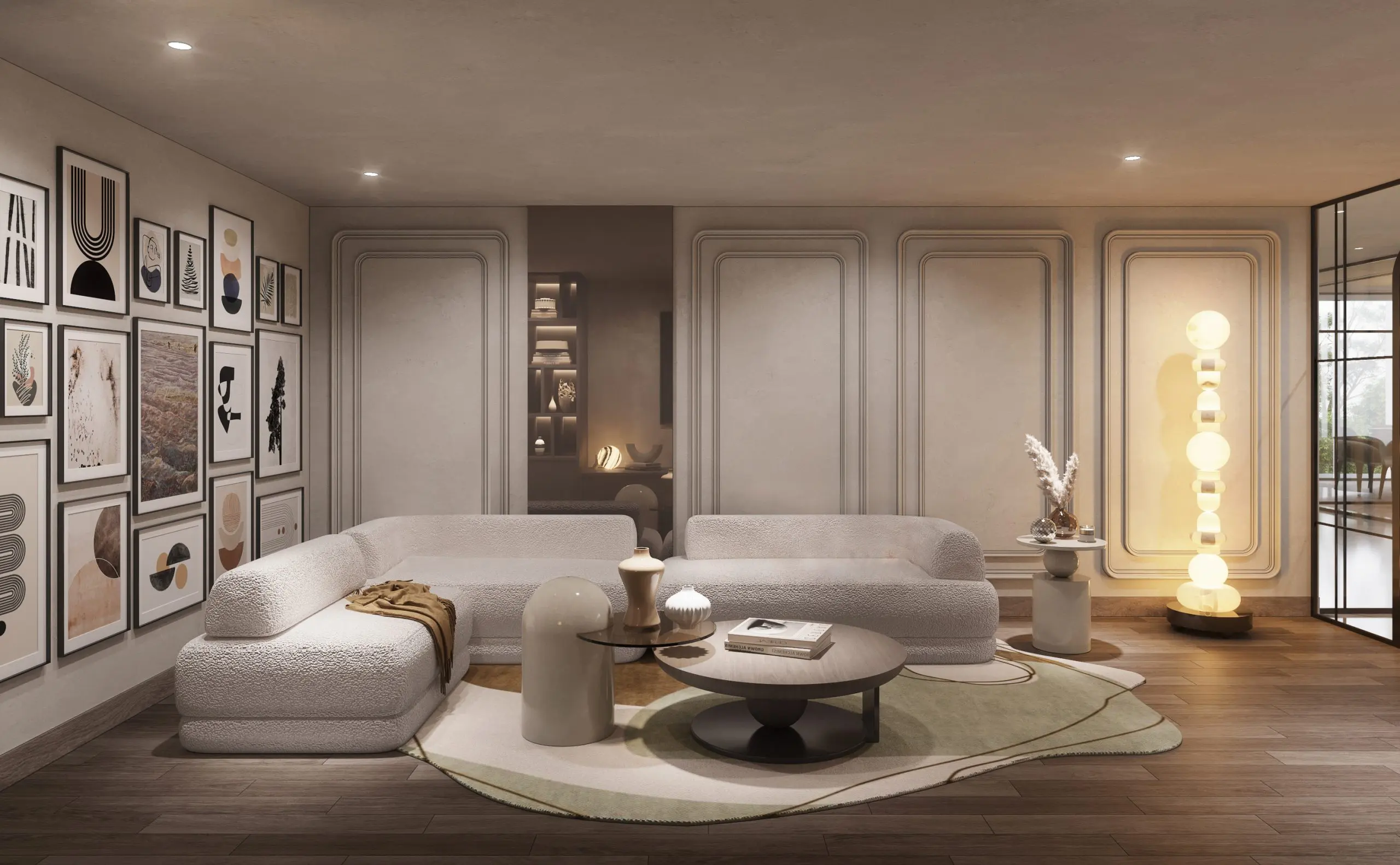
Curves are replacing corners. Designers agree that rounded forms soften the harsh geometry of urban architecture. In high-rise homes dominated by straight lines, curved seating introduces warmth and psychological ease.
At AE Living, curved forms are seen as emotional anchors that draw people inward. Bent Collective views sculptural seating as both comfort and visual storytelling. House of Lalittya emphasizes how curves break the boxiness of open layouts while doubling as art.
For Suvarna Joshi, the shift is deeply psychological. “Rounded forms hug the group together. They make a space feel less intimidating and more interactive.” — Suvarna Joshi, SD House.
Across studios, furniture is no longer static equipment. It shapes interaction. The curve is relational. It subtly choreographs how people sit, turn, and engage.
Material, But not Materialistic
If there is a defining element of the 2026 living room, it is tactility. Gayatri Khanna of Milaaya Interiors speaks of velvets, bouclé, handwoven linen, textured silks, and grasscloth panels that create depth and warmth. Stax Living emphasises honed marble, brushed brass, hardwoods, and woven fabrics that age gracefully.

Suvarna Joshi describes luxury as authenticity. Matte, leathered stones and textured veneers possess what she calls tactile soul.
Surfaces are no longer chosen for shine alone. They absorb sound. They temper light. They feel grounding. In cities grappling with environmental stress, sensory comfort is becoming an unspoken status symbol. Luxury is shifting from gloss to grain.
Comfort Has Gone Private
The recliner, once bulky and visually isolating, is being reimagined. Design forward silhouettes now conceal ergonomic mechanisms. Proportions are refined. Upholstery is elevated and comfort no longer disrupts aesthetics, it integrates into them.
Designers observe a broader cultural shift toward private luxury. The living room is not only a social stage. It is also a site of restoration. ‘Me time’ carries equal importance to entertaining.
Luxury is increasingly measured by how deeply a space allows one to exhale. The future of Indian luxury housing will not be defined by grand entrances or ornamental excess. It will be defined by nuance. By controlled micro climates. By flexible planning. By hospitality grade ambience translated into everyday living.