LuxeBook Exclusive: Vino Supraja On Redefining Indian Craft for the Global Runway
- Fashion Featured
 Anushka Manik
- 14 minutes read

If fashion had a conscience, it would probably look a lot like Vino Supraja. Architect by training, designer by destiny, and changemaker by choice, Vino’s journey is stitched with purpose. From reviving the centuries-old Bhavani Jamakkalam craft to taking Tamil folk art to the runways of London, she’s redefined what ‘made in India’ truly means. In an exclusive conversation with LuxeBook, Vino opens up about mindful fashion, her love for craft, and how storytelling can change the fabric of an industry.
LuxeBook: What was the spark that led you to create an entire collection around the Bhavani Jamakkalam?
Vino Supraja: When the producers of London Fashion Week approached me earlier this year, they asked if I had something special to showcase, since it would be my second time presenting on their platform. They had seen my previous collection, Purisai, inspired by the ancient Tamil folk theatre Therukoothu, where we staged an authentic performance on the ramp. They knew that storytelling rooted in culture was the soul of our brand. Even at Shanghai, Brooklyn, and New York Fashion Weeks, our collections have always drawn from heritage and human stories.
At that time, we were already collaborating with the Bhavani weavers and had just launched our luxury handbags made from the Jamakkalam textile. I was aware of how this once-flourishing craft was slowly fading, losing both visibility and demand. I felt an urgent need to bring it back into conversation—on a global platform where heritage meets modernity.
That’s how WEAVE: A Bhavani Tribute began. The first image that came to my mind was not of a garment, but of a moment—a senior weaver walking beside me on the London runway. Because these are the people who have kept the craft alive for generations. Taking all the limelight for myself felt unfair. The craft and its people deserved to share that stage.
This collection became my way of saying thank you to the hands that make fashion — to honour them, not just through words, but through a moment the world would never forget.

LuxeBook: When did you first encounter the Bhavani weaving community, and how did that experience shape your creative direction for this show?
Vino Supraja: We source my fabrics from Chennimalai, and during a business trip to Erode in 2024, I had a spare day. Bhavani is very close by, and my natural curiosity about crafts and processes led me to visit the town that day. What I witnessed stayed with me.
Once a bustling weaving hub known for its Jamakkalam rugs, Bhavani today carries quiet looms and aging artisans. When I spoke to the weavers, they told me that there were once over 5,000 looms across the town — now barely a fifth remain active. Most of the younger generation has moved away, reluctant to continue because demand has dropped and the income isn’t sustainable.
On my way back from Bhavani, that image of silent looms kept echoing in my mind. I kept asking myself why this vibrant, beautiful textile was losing its place in the world. Traditionally, Jamakkalams were used as floor rugs during auspicious occasions in Tamil Nadu, but lifestyles have changed — people no longer sit on the floor as they once did. We can’t ask the world to go back in time, but we can reinterpret heritage for today’s world.
That thought became the spark. I realised that the only way to preserve this precious craft is to reimagine its purpose. That was the beginning of our research and development journey — to transform the Bhavani Jamakkalam into something contemporary and relevant. That process led to the creation of our premium line of handbags and, ultimately, to WEAVE: A Bhavani Tribute at London Fashion Week 2025 — a celebration of both continuity and reinvention.

LuxeBook: Do you think fashion is finally moving towards giving equal credit to its makers?
Vino Supraja: Fashion is beginning to shift, yes—but we still have a long way to go. For too long, the spotlight has stayed on designers, models, and brands, while the real creators—the artisans and craftspeople—remained invisible behind the seams.
In recent years, there’s been a growing awareness, especially in sustainable and ethical fashion circles, about the human stories behind every garment. That conversation is powerful and necessary. But awareness alone isn’t enough. Recognition must translate into inclusion, visibility, and fair compensation.
For me, this is not just a professional responsibility—it’s deeply personal. I come from a background where service and community were part of everyday life, so I can’t separate the idea of fashion from the people who make it possible. That’s why, at WEAVE: A Bhavani Tribute, I decided to share the stage with a senior weaver, Mr. Sakthivel Periyasamy. It was a symbolic act, but also a call to the industry—to make this the norm, not the exception.
The hands that make fashion deserve to be seen, celebrated, and credited. When that happens, fashion will truly evolve from being just an industry of beauty to one of humanity.
LuxeBook: The finale gown was made of 400 connected panels. What was the creative and technical thought behind that piece?
Vino Supraja: Every time I take up an inspiration, I never translate it literally into garments. There always has to be my interpretation — and that interpretation usually takes an artistic route.
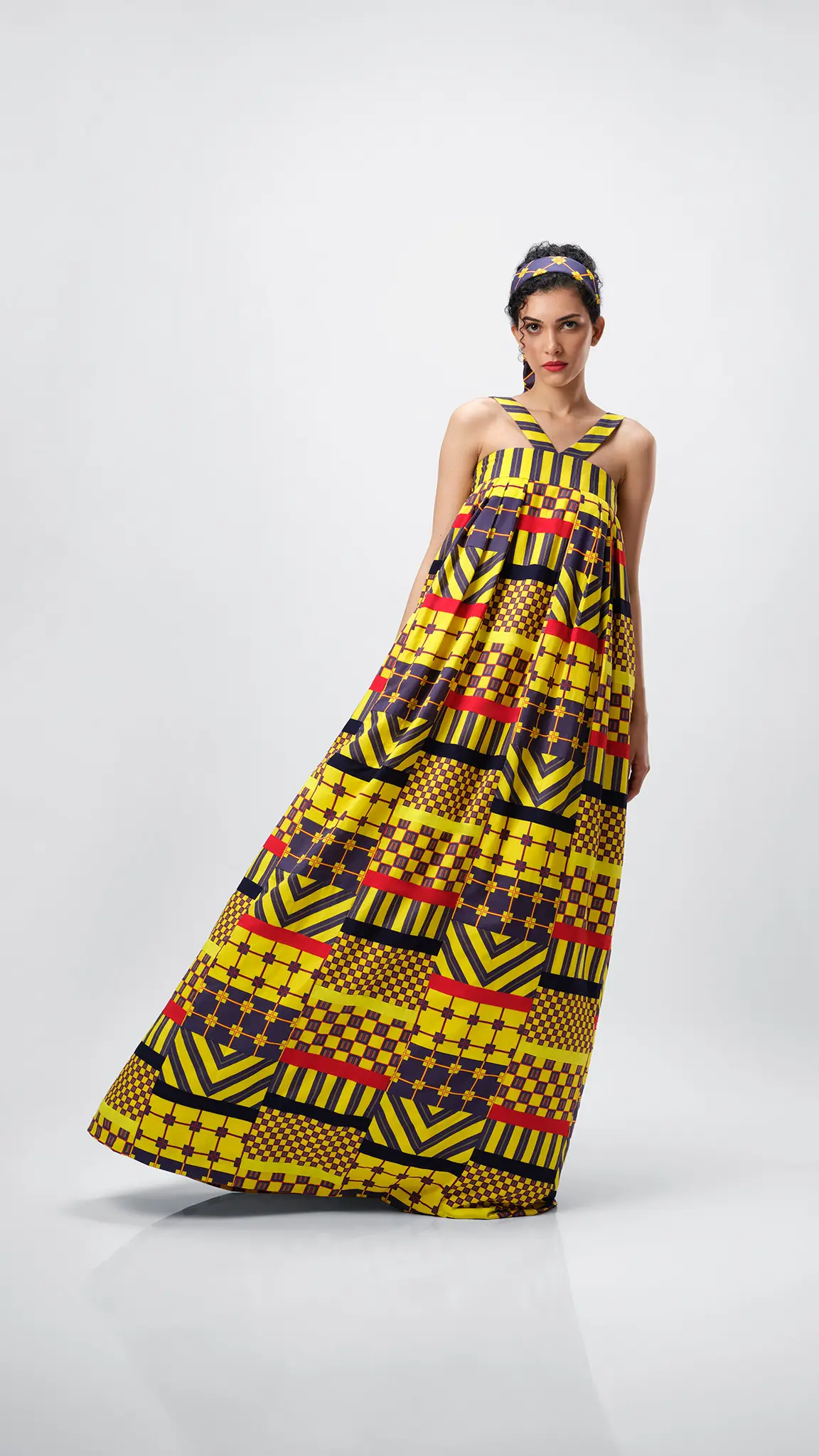
The Bhavani Jamakkalam has such a strong visual identity on its own — the bold colours, the striking stripes, and the rhythm of its geometry. My goal was not to replicate it, but to reimagine it. I wanted to explore its essence — colour blocking, proportion, and movement — through a more abstract lens. That’s how the idea of rhythmic patchwork was born.
For this collection, each garment began as a canvas of patchwork — but not random patchwork. Every piece was carefully measured, numbered, coded, and joined like a jigsaw puzzle to create harmony and flow. The process was intensely mathematical, yet deeply emotional.
The finale gown was the culmination of that entire journey. Made from over 400 connected panels, it symbolises how fragments of tradition can come together to create something modern and whole. Technically, it was one of our most challenging garments to construct — but creatively, it became the perfect metaphor for what this collection stands for: weaving the past into the present, stitch by stitch.

LuxeBook: You integrated traditional Tamil theatre and dance forms like Therukoothu, Thevarattam, and Thapattam into the runway experience. What was your intention behind this fusion of fashion and performance art?
Vino Supraja: When we decided to participate in London Fashion Week, the very first thought was to take a senior weaver, Mr. Sakthivel Ayya, with us to London. Every element of the show was then built around that one powerful moment — the moment when he would walk the ramp and be honoured.
Once that vision was set, I couldn’t imagine him walking on the runway to generic music. It just didn’t match the emotion of what we were trying to convey. This was not merely a fashion presentation; it was a cultural tribute. We wanted the music, movement, and visuals to celebrate the life and rhythm of the weavers.
That’s when we brought in Paul Jacob anna, a music director who has spent more than 25 years working with India’s folk musicians. He composed an extraordinary original track using ancient Tamil instruments like the Kombu, Thaarai, Pambai, Urumi, Jimla Melam, and Periya Melam. To this he added an English rap by BlaaZe, inspired by the poetry of Subramania Bharathiyar, with vocals by legendary folk artists Chinna Ponnu and Antony Dasan. It became a soundscape that was both ancient and contemporary — as rooted as it was global.
To introduce the actual Jamakkalam textile before the models walked, we wanted the audience to feel its soul. So, we staged a short performance choreographed by Palani Murugan anna from the Purisai Therukoothu lineage, blending the authentic footwork of Thevarattam and Thapattam. The piece was performed by Vaanmadhi Jagan, who brought the perfect balance of theatre and movement.
Together, the performance, the music, and the collection created an experience far beyond fashion. It was a celebration of Tamil culture — of art, rhythm, and craft — and an emotional tribute to the people who weave beauty into being.
LuxeBook: Was there a particular emotion or message you wanted the audience to take away as the show unfolded?
Vino Supraja: The entire show was an emotional journey — not just for the audience, but for all of us backstage too.
When Vaanmadhi’s performance began with Tamil folk music, showcasing the Jamakkalam in its purest form, the audience was completely taken by surprise. The movements, the rhythm, the rawness of it — it was something entirely new to the Western audience. And when the performance ended, we could hear the “wow” from backstage. That moment set the tone for everything that followed.
As the models walked out one by one, the play of colours, the balance of geometry, and the rhythm of the patchwork brought smiles and applause from the audience. The music by Paul Jacob anna made people tap their feet; the energy in the room was palpable. We could even hear people humming Chinna Ponnu akka’s vocals long after the show had ended.
And then came the finale — the moment Sakthivel Ayya and I walked the ramp together. The hall fell silent for a few seconds, then came smiles, followed by tears. Many in the audience came up to us later and said they felt deeply moved — that they’ve seen “Made in India” on their clothes, but had never seen the person who actually made them.
Later, a message on LinkedIn from Lisa Honan CBE, former Governor of St. Helena and UK Ambassador to Nepal, made me realise the depth of that moment even more. She wrote that Devonshire Square — where our show took place — was once an East India Company warehouse where Indian woven cloth was stored. To bring a weaver back to that very space, centuries later, and honour him on that stage — it felt as if history itself had come full circle.
LuxeBook: For you, what does “sustainable luxury” truly mean today?
Vino Supraja: For me, sustainable luxury is not a trend — it’s a value system. It’s about creating something beautiful without causing harm — not to the environment, and not to the people who make it. True luxury lies in consciousness — in knowing who made your garment, how it was made, and what impact it leaves behind.
Luxury, to me, is about care — the time, patience, and human touch that go into making something extraordinary. When you hold a handwoven textile or wear something made by an artisan, you are not just wearing fashion; you are wearing someone’s story, someone’s skill, and generations of culture.
Sustainability goes beyond choosing organic fabrics. It’s about fairness, dignity, and respect. It’s about ensuring the person who weaves your cloth or stitches your dress earns enough to live a good life, not just survive.
Our brand stands for this philosophy — where every design celebrates craftsmanship, culture, and compassion in equal measure. Sustainable luxury, for me, is about slowing down and valuing the human connection behind fashion. Because the future of luxury will not just be about how it looks — it will be about how it feels, how it’s made, and how responsibly it touches lives.

LuxeBook: What are some misconceptions people still have about handloom or heritage fashion that you’d like to change through your work?
Vino Supraja: One of the biggest misconceptions about handloom or heritage fashion is that it belongs to the past — that it’s something to be admired in museums, not worn in modern life. Through our work, we want to challenge that idea. Handloom is not old-fashioned; it’s timeless. The weaves, patterns, and techniques carry an intelligence that has sustained for centuries. They only need to be reimagined, not replaced.
Another misconception is that handloom means “less refined” or “not luxurious.” In reality, handloom is the highest form of luxury because it is made with time, patience, and human skill — things machines can never replicate. Every small imperfection in a weave is a fingerprint of the artisan, a mark of authenticity, and that’s what gives it value.
There’s also a tendency to romanticize crafts without truly valuing the people behind them. Many assume artisans are just “workers,” when in fact they are designers, engineers, and artists in their own right. Through our collections, we aim to change this narrative — by giving credit, visibility, and dignity to the makers.
Our goal is to show the world that heritage and modernity are not opposites. When you wear handloom, you are not looking back — you are carrying forward centuries of culture, art, and human connection into the future.
You may also read: The Best Wellness Spots in Delhi for a Post-Diwali Cleanse