Pooja Bhansali on materiality, memory and the art of slowing down
- Fashion Featured
 Yashita Damani
- 9 minutes read

Mumbai-based artist Pooja Bhansali, whose practice bridges fine art, fashion, and textile, recently presented Grid & Garden, her debut solo exhibition at the storied Jehangir Art Gallery. Working in mixed media that spans upholstery fabric, silk brocade, ceramics, resin, and three-dimensional textile embellishment, Bhansali has built a visual language that refuses easy categorisation. We sat down with her to talk about materiality, memory, and what it means to make art that asks you to slow down.
LuxeBook: Your artistic language is rooted in texture and materiality. When did you realise the surface itself could become part of the story?
Pooja Bhansali: It happened gradually. My background is in fashion and textiles — I trained at FIT and Parsons — so I was always thinking about how fabric behaves, how it holds memory. When I began making art, I couldn’t leave that instinct behind. I started layering upholstery fabrics and brocade silks onto the picture plane and realised the surface wasn’t just a support anymore — it was speaking. A piece of tweed carries weight and history before a single mark is made. That tactile intelligence became my language.
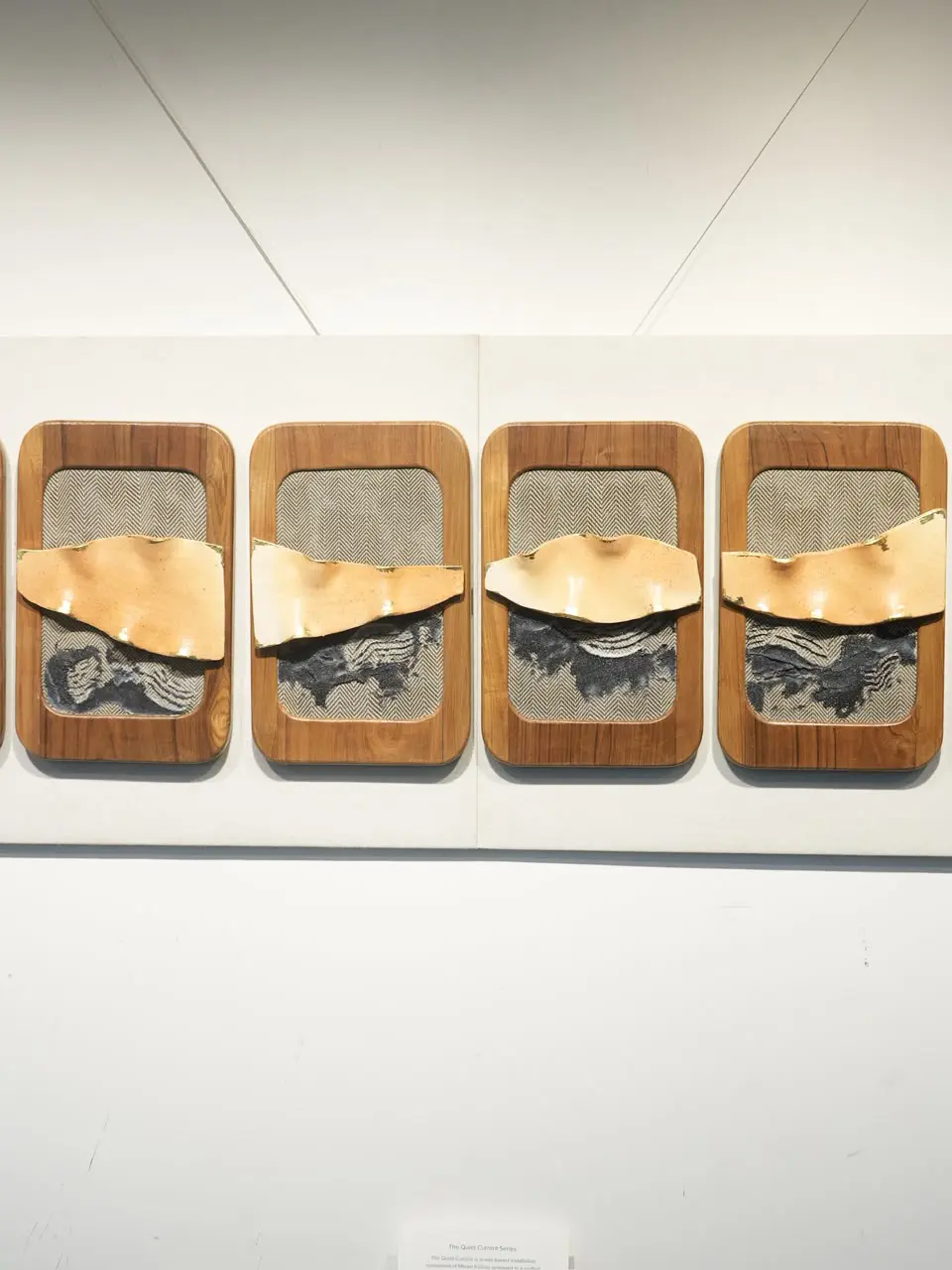
LuxeBook: Grid & Garden explores structure and softness in equal measure. What sparked this dialogue?
Pooja Bhansali: It’s a tension I live inside. The grid is the city — logic, architecture, the framework we build our lives within. The garden is everything that insists on growing through the cracks anyway. I wanted the works to hold that contradiction without resolving it, because I don’t think it does. The most interesting space is where those two forces meet and negotiate.
LuxeBook: Texture feels central to your work — from tweed and silk brocade to gold foil and ceramics. How do materials shape meaning for you?
Pooja Bhansali: I choose materials the way a writer chooses words — for what they already mean before I add anything. Gold foil speaks of opulence and fragility in the same breath. Brocade silk has centuries of ceremony embedded in it. Ceramic is both ancient and breakable. When I bring these into a work, I’m not decorating — I’m in conversation with what those materials already carry. My job is to direct that conversation toward something new.
LuxeBook: Your works exist between painting, textile, and sculpture. Was this hybrid visual language always intentional?
Pooja Bhansali: At first it was instinctual more than intentional. I simply couldn’t work within just one category. Fashion gave me textiles, fine art gave me the picture plane, and the three-dimensionality came from refusing to flatten what wanted to be raised. Over time I understood the hybridity was the point. These boundaries — between painting and craft, fine art and applied art — are largely inherited and often exclusionary. My practice lives in the refusal of those divisions.
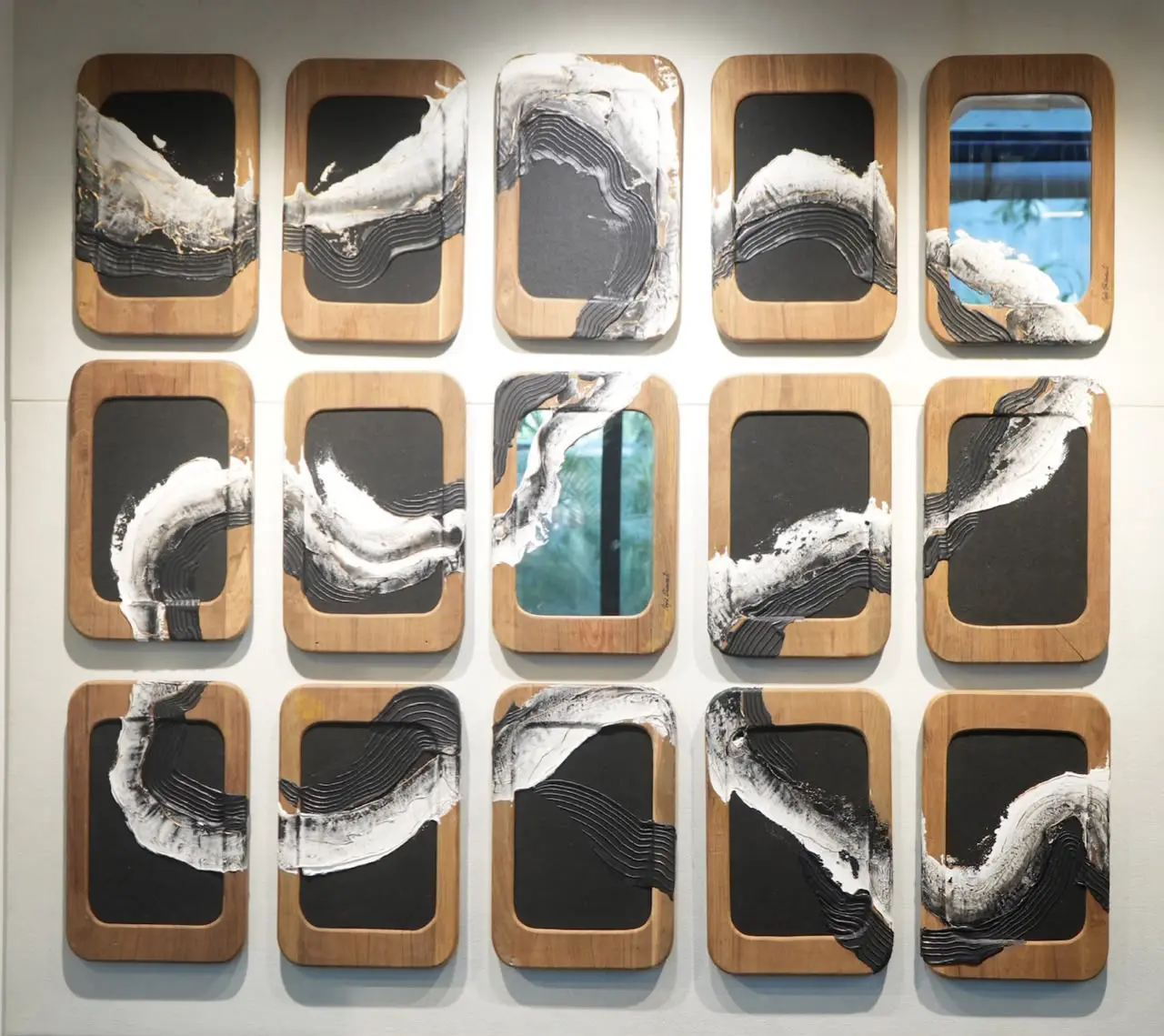
LuxeBook: Nature and urbanity quietly coexist in the collection. Are you reflecting on the tensions of modern living?
Pooja Bhansali: Less a reflection, more a felt experience. I’ve spent significant chapters of my life in Mumbai and New York — two cities that are enormously alive and also relentless. You learn to find softness in small pockets: a window vine, a market flower, light through a building gap. Grid & Garden holds that. I’m painting what it actually feels like to search for the organic within the structured — and to find, surprisingly often, that it’s there.
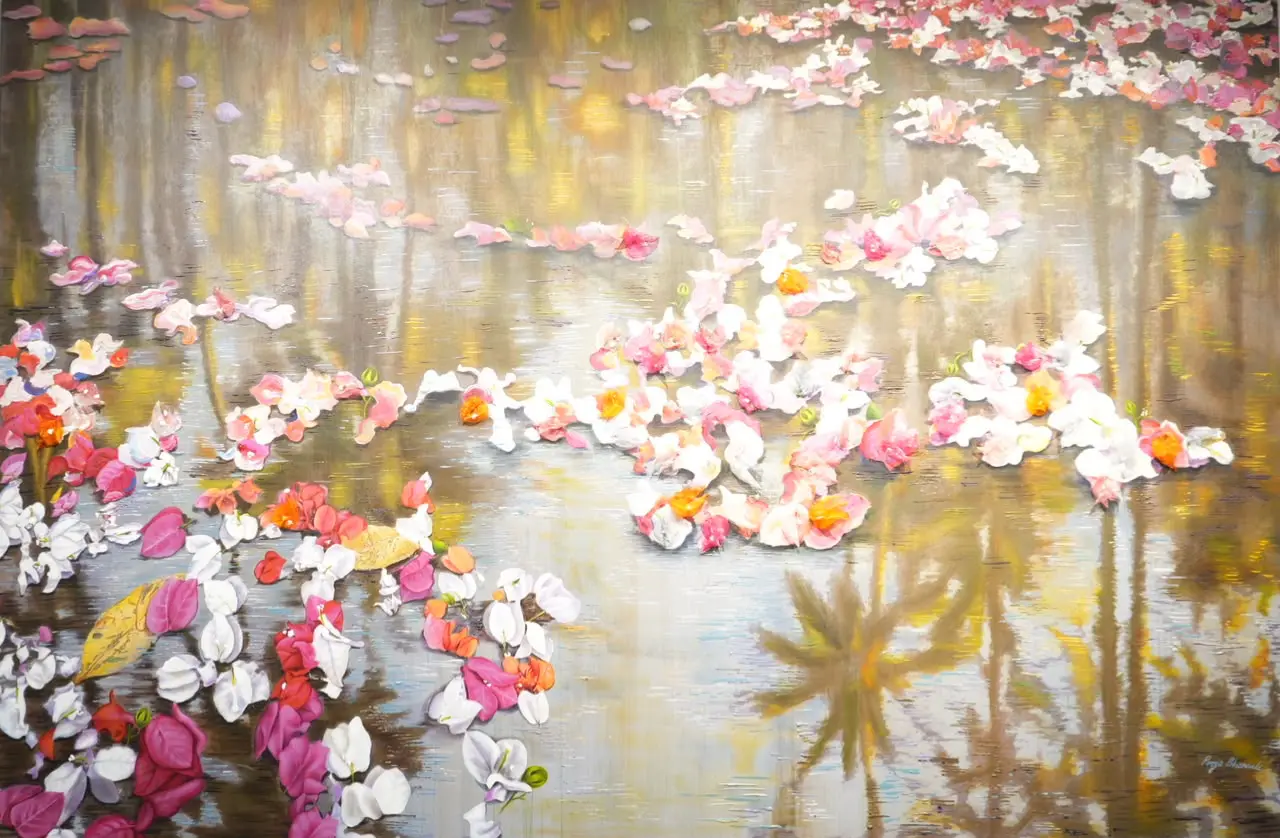
LuxeBook: Bougainvillea Reflections carries echoes of Impressionism. How do you reinterpret classical influences through a contemporary lens?
Pooja Bhansali: The Monet reference in that piece was entirely intentional. I’ve long been drawn to his Water Lilies — that obsession with light, reflection, and the meditative quality of water. I wanted to carry that spirit into something geographically closer to my own life, replacing the French water lily with the bougainvillea that blooms so vividly around Mumbai. But I couldn’t stop at paint. I hand-dyed organza and constructed three-dimensional bougainvilleas, stitching them directly onto the canvas so they sit proud of the surface — almost floating. The hope is that standing before it, you feel something of what Monet chased: the sensation of being at the edge of water, with blossoms resting on top. It’s art history filtered through where I actually live, and through the textile instinct I can’t leave behind.
LuxeBook: Themes of resilience and transformation recur throughout your work. How much of your personal journey informs the practice?
Pooja Bhansali: All of it, though I try not to make the work confessional. The arc — Mumbai to New York, a decade in each, the detours through Japan and Chicago, the return — wasn’t a neat story. There was a lot of becoming and unbecoming. But those experiences live in the work structurally, in the way I build surfaces in layers, in the materials I’m drawn to that hold tension and still hold together. Resilience in my work isn’t triumphant — it’s quiet and textured.
LuxeBook: In an age of digital overstimulation, your work invites viewers to slow down. Is creating moments of pause intentional?
Pooja Bhansali: Deeply so. I think about the physical experience of standing before a work — the slowing of breath, the movement toward the surface to understand what it’s made of. Texture demands that; you can’t absorb these works on a small screen at scroll speed. They ask for presence. Making highly tactile art right now feels like a quiet act of resistance — an insistence that some things still require your full body’s attention.
LuxeBook: How do you define luxury in contemporary art today?
Pooja Bhansali: As time and intentionality — the sense that something was made slowly, with full attention, without compromise. It has nothing to do with price, though material richness can be part of it. When I use silk brocade or hand-applied gold foil, I’m not signalling expense — I’m signalling care. Luxury, in the truest sense, is the opposite of the throwaway. It’s something that rewards sustained looking.
LuxeBook: What does your debut solo at Jehangir Art Gallery represent for you at this stage of your journey?
Pooja Bhansali: An arrival that took longer than I expected and exactly as long as it needed to. Jehangir carries the weight of Indian art history — to stand in it with a body of work that is wholly mine feels significant in a way I’m still absorbing. Grid & Garden is the first time everything I’ve been working toward — the materials, the ideas, the visual language — existed together in one room. It marks the moment the practice became undeniable, to others and to myself.
You may also read: These green dial luxury watches deserve a spot in your wishlist