Vacheron Constantin Pays Homage to Ptolemy and Copernicus on 270th Anniversary
- Fashion Featured Retail
 Yashita Damani
- 9 minutes read

To mark its 270th anniversary, Vacheron Constantin has released two single-piece editions under its new Les Cabinotiers ‘La Quête’ series — The Celestia Astronomical Grand Complication – Homage to Ptolemy and – Homage to Copernicus.
Dedicated to the study of astronomy and inspired by ancient odysseys of discovery, the collection celebrates the Maison’s mastery of astronomical complications and decorative crafts.

A tribute to the great astronomers
Since ancient times, mankind has sought to understand the rhythms of the universe — from the cycle of seasons to the alternation of day and night. The Celestia Astronomical Grand Complication pays tribute to two major astronomers whose theories shaped the understanding of space-time.
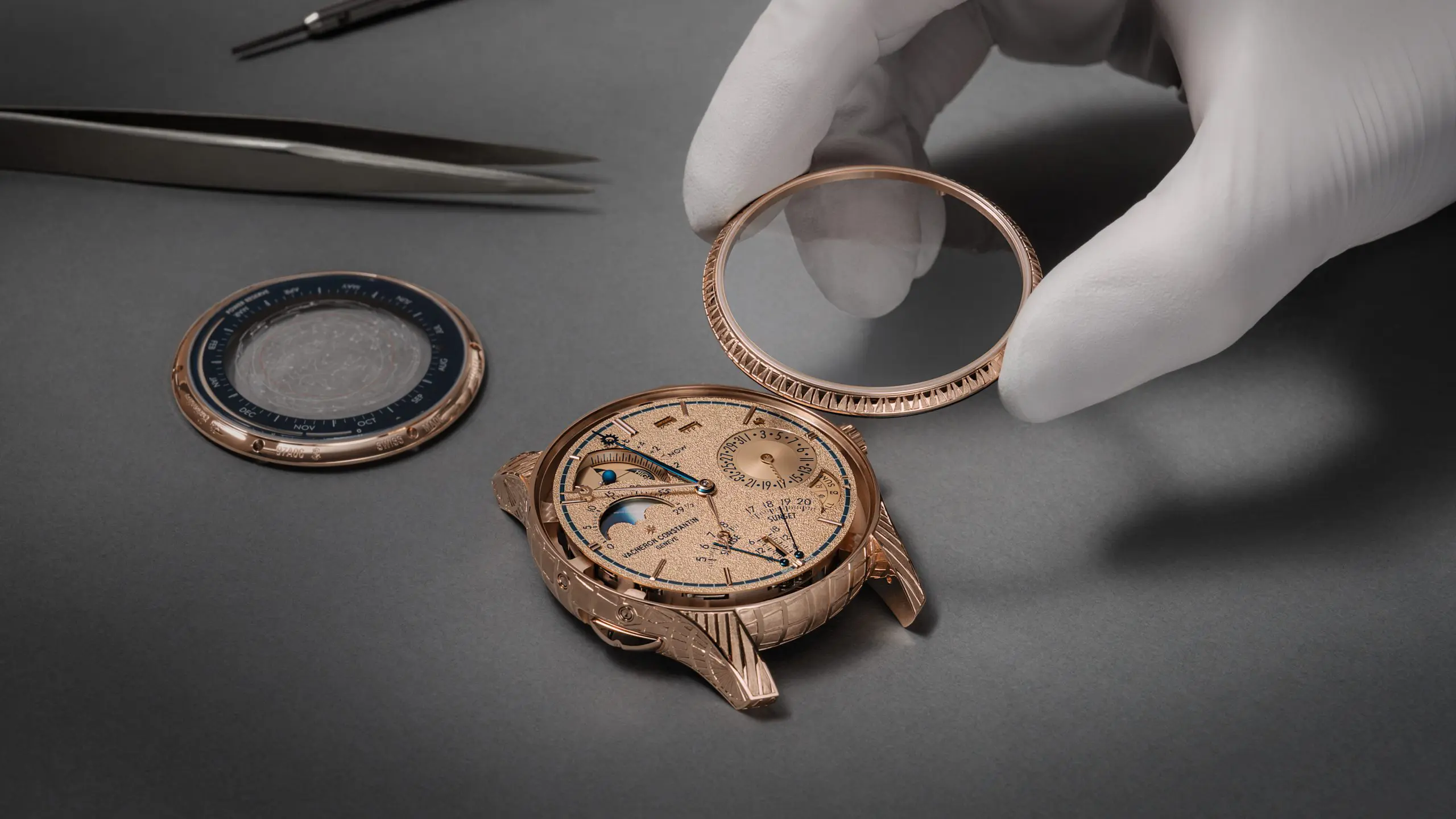
The Homage to Ptolemy illustrates the geocentric universe imagined by the 2nd-century Alexandrian astronomer, in which Earth remained motionless at the centre, with the stars and planets revolving around it.
The Homage to Copernicus on the other hand reflects the heliocentric model developed by the Polish astronomer Nicolaus Copernicus, who identified the Sun as the centre of the universe, reviving the long-forgotten heliocentric theory of Aristarchus of Samos (yes, the same guy who proposed that the Sun is at the centre of the universe and the Earth revolves around it).
Each double-sided timepiece interprets these cosmic systems through detailed engraving on its case: a visual tribute to the celestial movements envisioned by these great scholars.
Three readings of time

The Celestia Astronomical Grand Complication displays three distinct time readings — civil, solar, and sidereal, each powered by its own gear train.
Civil time and solar time are indicated by central openworked hands on the front dial. Due to Earth’s elliptical orbit and the 24° inclination of its axis, the duration between two solar zeniths varies slightly each day. This difference, known as the equation of time, ranges from -16 to +14 minutes over the course of the year.
A ‘cam mechanism’ mechanically programs this variation, while a ‘sun’-tipped minute hand shows the running equation of time, providing instantaneous reading of both solar and civil times.
Sidereal time appears on the reverse, displayed via a celestial map formed by two sapphire discs: a fixed upper disc marked with constellations and a rotating lower disc. As Earth completes a full rotation relative to fixed stars, a sidereal day measures exactly 23 hours, 56 minutes, and 4 seconds (four minutes shorter than the solar day).
The sidereal time scale runs along the edge of the mobile disc, which completes its rotation four minutes faster than civil time. A yellow triangular pointer indicates the current date, while a blue ellipse represents the visible constellations in real time. The celestial equator and ecliptic are traced in white and red elliptical lines respectively.
Astronomical mastery

The front dial features seven additional astronomical complications arranged on a grained background of 18K white or pink gold, depending on the model. A perpetual calendar displays the days, months, and leap years, programmed until the year 2100. A precision moon phase at 9 o’clock requires only one correction every 122 years, showing both the age of the Moon and the day-night cycle.
The dial also presents sunrise and sunset times, the length of day and night, the zodiac, seasons, solstices, equinoxes, and a mareoscope — or tide gauge — that shows tidal levels and Earth-Moon-Sun alignments.

On the reverse, the sidereal display is complemented by a three-week power reserve indicator. The movement is regulated by a one-minute tourbillon shaped like Vacheron Constantin’s Maltese cross emblem, visible through an aperture on the back.
Each watch is powered by the Calibre 3600, a manual-winding movement developed over five years and composed of 514 components and 64 jewels. With a thickness of just 8.7 mm, it offers a three-week power reserve via six barrels mounted in series.
Champlevé engraving
Both timepieces are intricately hand-engraved using the champlevé technique.
On the Homage to Ptolemy, the case depicts the planets orbiting Earth, with the planetary ellipses engraved onto the bezel and lugs. The engraver hollowed spaces between the ellipses to depths of 0.1 to 0.2 mm, creating a sandblasted background that contrasts with the polished orbital lines. Each planet appears subtly domed and textured, while Earth features hand-polished continents.
For the Homage to Copernicus, the crown symbolises the Sun radiating across the lugs and case. Here, the planetary orbits are positioned asymmetrically, requiring a special compass tool to trace circular arcs beyond the case boundary.
Fun fact: The engraving alone required 240 hours of work for each watch!
Both pieces are created in 18K gold: white for Ptolemy and 5N pink for Copernicus; with matching engraved folding clasps and dark blue Mississippiensis alligator leather straps.
Technical Challenge
Selmoni notes that the main technical challenge was to combine rare complications, such as the tide gauge and Earth-Moon-Sun alignment, in a compact and legible layout. Artistically, the challenge lay in achieving geometric precision within engravings only tenths of a millimetre deep, across curved surfaces like the bezel and lugs.
Representing a dialogue between science, philosophy, and craftsmanship, these single-piece creations embody the enduring spirit of La Quête: a tribute to humankind’s eternal pursuit of knowledge and beauty written across the stars.
Just a thought for you to end the week since the company motto of Vacheron Constantin is “Faire mieux si possible, ce qui est toujours possible” (Do better if possible, and that is always possible).
You May Also Read: The Stylist’s Cheat Code to Weddings