Walking Through NMACC’s ‘POP: Fame, Love, and Power’ Exhibit
- Art Featured
 Zara Flavia Dmello
- 9 minutes read

Before you push open the doors to the Art House at NMACC, you must brace yourself for the 45 radiant smiles of Marilyn Monroe, printed onto a 120-inch-long canvas, each one beckoning you into the hollow room. The sheer size of it alone, is enough to baffle.
Fittingly, the entire first floor displayed paintings on the theme of Fame, with key artworks reflecting the rise of celebrity culture in 1960s and ’70s. America, including of course, the Forty-five Gold Marilyns. Here, four of Warhol’s 40 x 40-inch portraits of cultural personages, Arethra Franklin, Sylvester Stallone, Georgio Armani and Gianni Versace, stood firmly beside each other in his quintessential silkscreen style, and Ed Ruscha’s Hollywood inspired texts claimed his love for the movies.

On a long wall at the back of the room, a quote from Warhol accompanied 20 stunning black and white photographs of a number of public figures: “my idea of a good picture is one that’s in focus and of a famous person…”. The wall unfortunately forgets to complete the quote: “…doing something unfamous.” All this obsession with celebrity, pop culture and humanising household names; one thing became unmistakably clear. Warhol would have loved Instagram.

The next two floors were titled Love and Power, respectively. Lawrence Van Hagen, curator of the exhibit, neatly segregated the pieces according to these three themes, a clever format that ensured not to fumble any key message of the movement. Through POP: Fame, Love, and Power, Van Hagen sought to acquaint young Indians with the relevance of Pop Art in the 21st century. For a generation raised amidst ubiquitous advertising, pop culture, and mass consumerism, he found Pop Art – which derived inspiration from these very influences- to be a pertinent and valuable genre to initiate fresh dialogues on these topics.
As we made our way up the flights of stairs, whispers of post-modernism echoed throughout the four-storey space and, my friend and I exchanged looks of playful chagrin. On the second floor titled Love, Robert Indiana’s 6-foot sculpture of the same name sat squarely in the middle of the room. But, it was Keith Haring’s work, namely a gigantic, vibrant tarpaulin from 1988, that felt most urgent (and a tad less on the nose) to the idea of love in the age of Pop. The untitled piece depicted the artist’s trademark stick figures intertwined and dancing together, nodding to New York City’s pulsating cultural scene, and presently offering the vast white walls of the space with bright colour.

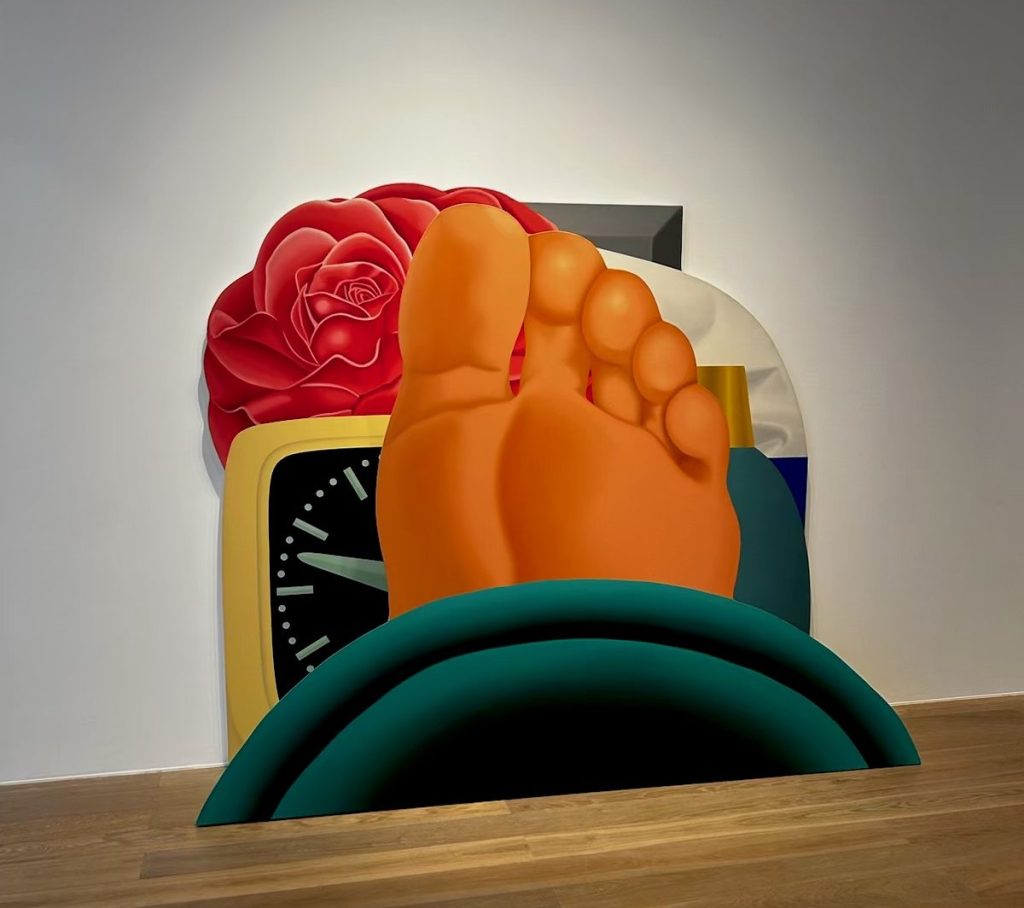
It was on this floor that I found Tom Wesselman’s standing still-lifes (Bedroom Painting 24 and Gina’s Hand) to be especially instrumental in driving home Pop Art’s original intention of re-imagining what subjects deserve to become art. Here, everyday visuals like a foot, a clock and a flower are presented with an almost voyeuristic eye, enlarged and transformed into artistic statements.
The last of the themed storeys, Power, featured works by Oldenberg, Sturtevant, Lichenstein, Rauschenberg, and more, that touched upon concepts of branding, television, and media. Pieces like Sixteen Jackies, Gulch, Dollar Sign, Fishing Village and others mapped the growing grip of these entities on the American psyche through the ’60s and ’70s.

I spent more of my time on the Power floor than any other, and walked out, a newfound fan of Rauschenberg and his 9-metre collage, Periwinkle Shaft. My friend and I stared at the painting generously, counting several American motifs and attempting to theorise what it was about.

After we fell painfully off the mark with our theories we proceeded to the fourth and final floor where Warhol’s Silver Clouds awaited us. This 1966 touch-friendly installation invited viewers to interact with helium-filled metallic balloons, floating around the room.
The incorporation of Silver Clouds into the exhibition served as another instance of the city embracing a burgeoning trend of immersive installations. In Mumbai, the popularity of Yayoi Kusama’s Infinity Mirrored Room and the Van Gogh 360° experience attests to the triumph of such an art model among Indian audiences.
The exhibit, at large, seemed to break free from conventional gallery formats, and in doing so, attracted a diverse viewership, extending far beyond the usual art enthusiasts. One of the cultural centre’s many missions was to bring global art to India and give Indians the opportunity to develop a keen eye for a spread of art forms. POP: Fame, Love, and Power delivered on that promise, not by preaching Pop’s legacy, but putting its sharpest ideas forward, laying bare how it looked, moved, and sold in its time.
Exhibition on till February 11th, 2024.
- Tuesday – Thursday, & Sunday: 11am – 8pm.
- Friday and Saturday: 11am – 10pm.
- Entry to this exhibition is free for students of fine arts, children under the age of 7 and senior citizens.