The nine lives of Gin

By: Indu Joshi
Cats may have nine lives, but gin has managed a few impressive reincarnations of its own. Over four centuries, it has transformed from medicine to menace, colonial companion to cocktail icon, and today stands as one of the world’s most inventive spirits.
The story of gin begins not in Britain, but in the Netherlands. Long before London claimed it as its own, there was jenever, a juniper-flavoured spirit distilled by Dutch producers and prescribed by physicians. Juniper was believed to possess medicinal qualities, making early gin less of a social lubricant and more of a liquid prescription.
Its second life arrived on the battlefield. English soldiers fighting alongside Dutch troops reportedly drank jenever before combat to steady their nerves, giving rise to the phrase ‘Dutch Courage’. Whether it improved their aim is uncertain. It almost certainly improved their optimism.
Gin’s third life was far less respectable.
By the early 18th century, London had developed an extraordinary appetite for the spirit. Cheap to produce and widely available, gin flooded the city. At the height of the Gin Craze, thousands of establishments sold it, and consumption soared to such levels that politicians, church leaders and social reformers were horrified.
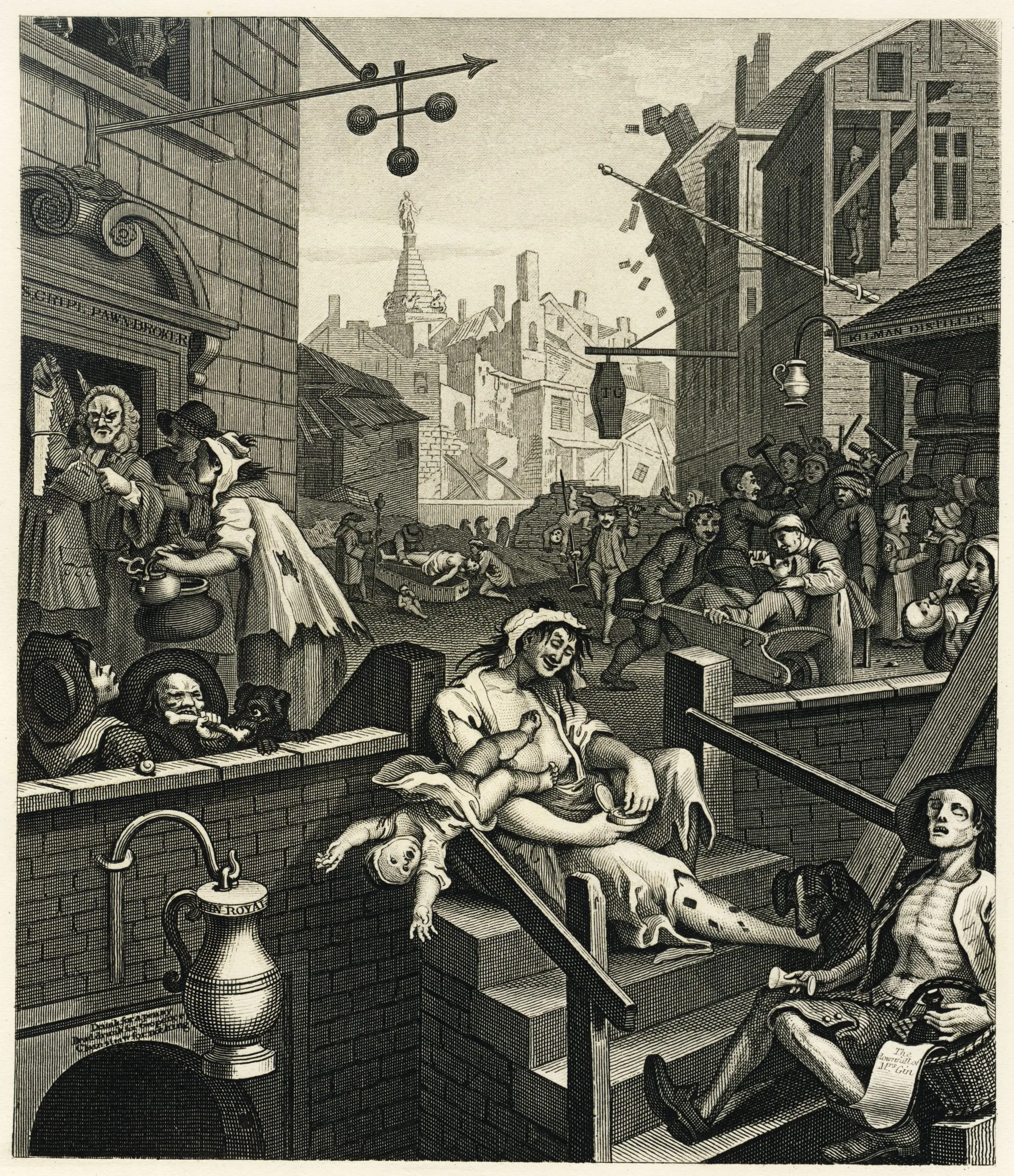
Gin earned the nickname “Mother’s Ruin“, with London as a city seemingly drinking itself into oblivion. Artist William Hogarth immortalised the chaos in his famous engraving Gin Lane, depicting a city seemingly drinking itself into oblivion. Few spirits have inspired an entire moral panic.
Yet gin survived.
Its fourth avatar saw it move from London’s poorest districts into some of the most exclusive clubs and drawing rooms of the British Empire. As officers, traders and administrators travelled across Asia and Africa, they carried their favourite spirit with them. Gin became synonymous with colonial evenings, wicker chairs, whirring ceiling fans and sundowners served as the heat of the day began to fade.
Then came life number five: the accidental creation of one of the world’s most famous drinks.
Tonic water was originally consumed because it contained quinine, used to combat malaria. The problem was that quinine tasted dreadful. Someone eventually decided that adding gin might improve matters. It did. Considerably. The Gin & Tonic remains perhaps history’s most successful example of medicine being improved by alcohol.
Life six brought glamour.

As cocktail culture flourished in the early 20th century, gin found itself at the centre of fashionable society. The Martini emerged as a symbol of sophistication, served in elegant hotel bars and immortalised in films, novels and advertisements. Entire friendships have probably been lost arguing about the correct ratio of gin to vermouth.
Which brings us to life number seven: celebrity.
Ian Flemming’s James Bond elevated gin cocktails into the realm of legend. In Casino Royale, Bond introduced readers to the Vesper Martini-a formidable blend of gin, vodka and Kina Lillet and forever immortalising the phrase “shaken, not stirred.” Although the films later popularised vodka martinis, Bond’s original drink was unmistakably gin-forward.
Bond was hardly gin’s only champion. Writers, actors and socialites helped turn gin into a symbol of sophistication throughout the 20th century. Ernest Hemingway declared that “a gimlet is just about the best thing one can have,” while poet and wit Dorothy Parker delivered perhaps the most famous tribute of all:
“SlI like to have a martini,
Two at the very most.
After three I’m under the table,
After four I’m under my host.”
By the mid-20th century, gin had become the drink of choice for everyone from literary wits to Hollywood leading men. It helped cement the spirit’s association with elegance, intrigue and impeccable tailoring.

By the late 20th century, however, gin’s fortunes began to fade.
This was life eight: near extinction. Vodka’s clean, neutral profile captured the public imagination and gin suddenly seemed old-fashioned. For a time, it risked becoming the drink your grandparents ordered while everyone else chased newer trends.
Many spirits never recover from such moments. But Gin did.
Its ninth life is the great gin revival – the one we’re living today.
The craft spirits revolution transformed gin into a canvas for creativity. Distillers began experimenting with local ingredients, unusual botanicals and regional identities. Suddenly gin was no longer just about juniper. It became a playground for creativity. Lavender, tea, seaweed, olives, mountain herbs, peppercorns, citrus blossoms and dozens of other ingredients found their way into stills. Suddenly gin has become a storyteller. Every bottle seems to carry a narrative: a landscape, a memory, a spice route, a garden or a cultural tradition. And nowhere is this transformation more visible than in India.
Long known as a source of some of the world’s most prized botanicals, including pepper, cardamom, coriander and juniper. India has emerged as one of the most exciting gin-producing regions in the world. Contemporary Indian gins draw inspiration from forests, mountains, spice markets and tea gardens, creating flavour profiles that are unmistakably local yet globally relevant.

Unlike many spirits that remain closely tied to a single tradition, gin has always been a shapeshifter. Perhaps that’s the reason for its longevity. Whisky may pride itself on tradition, rum on romance and vodka on versatility, but few spirits have changed identities as often, or even as successfully, as gin. It has been medicine and menace, colonial companion and cocktail icon, literary muse and craft darling. Gin may have had nine lives already, but, given its remarkable resilience and enduring appeal across generations, it may well have many more than the proverbial cat. Which is fortunate, because it doesn’t seem remotely interested in retirement.