For Sahil Kochhar, morning begins at sunset: A first look at ‘Savera’
- Fashion Featured
 Yashita Damani
- 9 minutes read

“Beginnings do not need permission from the clock.”-Sahil Kochhar
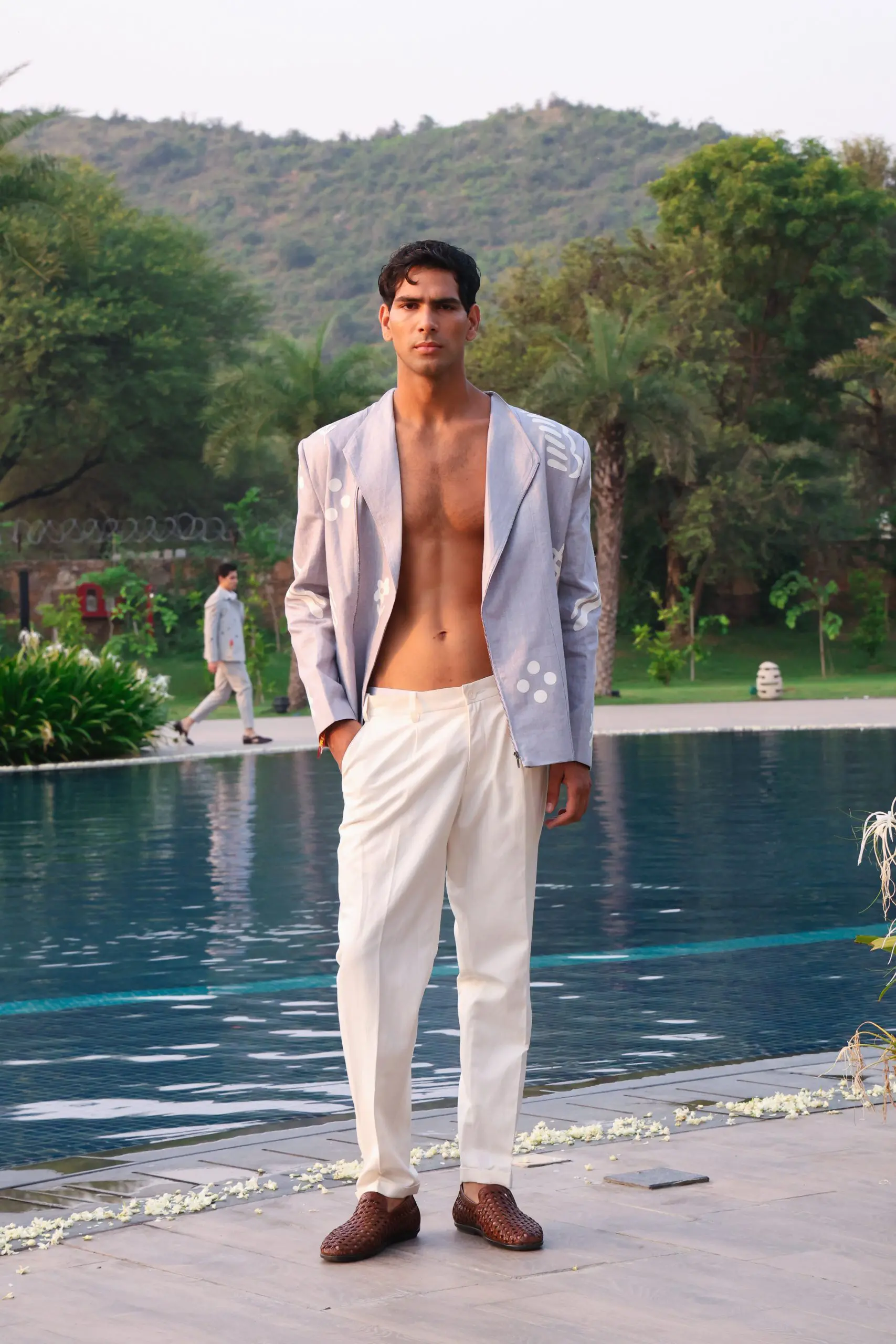
Ever heard of a runway taking a dip or a morning arriving at sunset? At Ananta Ajabgarh, Sahil Kochhar’s Spring/Summer 2027 collection, Savera did exactly that; bringing models, embroidery and a little poolside drama to the Aravallis. “It is that exact moment a day decides to wake up, all at once, joyfully, without asking permission.” -Sahil Kochhar
Kochhar has taken his dimensional appliqué and pushed it into more technical territory, with hundreds of shapes cut by hand and laser, then layered and stitched into sculptural forms. In some of the standout pieces, the threadwork becomes so extensive that the embroidery itself becomes the textile.
“One of the things I’m most excited about is that we experimented with creating our own textiles through extensive threadwork and embroidery,” Kochhar says. “In several pieces, the embroidery itself becomes the textile.”

“Some mornings arrive at the end of the day”, says Sahil Kochhar
The showcase landed neatly between the day’s Tastemakers’ Table programming and the night’s festivities. Guests had already gathered for The Wild Table brunch at Sariska Lounge and a tree planting initiative before returning to the resort for the poolside red carpet and drinks. At 5pm sharp, Savera stepped out. Then came golden hour, a sundown party and barbecue dinner under the open sky. Which brings us back to that slightly mischievous name. Savera means morning, but perhaps Kochhar was never really interested in telling us what time of day it was. He was interested in that feeling of possibility when a new day has not yet decided what it will become. And we, were interested to see if his clothes survived the chlorine.
In Conversation with Sahil Kochhar

LuxeBook: What was the vision behind presenting your collection at Ajabgarh, and how did the location shape your approach to the show?
Sahil Kochhar: Ananta Ajabgarh sits right in the heart of the Aravallis, close to the Sariska Tiger Reserve, and the moment I stood there, I knew this collection could not exist anywhere else. My work has always leaned on nature, landscape, and the quiet humdrum of wildlife, so an open hill as a stage felt less like a choice and more like something the land itself was offering us. We built the whole show around the pool with the hills rising right behind the runway, no walls, no ceiling, just that landscape holding the collection the way it held me the morning I first saw it.
LuxeBook: Savera means morning, but you unveiled it at sunset. Why this beautiful contradiction? Was that fashion’s way of saying, “who says morning has to be in the morning?”
Sahil Kochhar: I love that contradiction, and I did not try to smooth it over. Savera means dawn, but the feeling I wanted, that particular hush before the world decides what kind of day it will be, doesn’t belong to one hour. It belongs to a state of mind. Watching it unfold at sunset, with that same soft gold light settling over the Aravallis, felt like proof that beginnings do not need permission from the clock. Some mornings arrive at the end of the day. And even now, after all these years, I still find myself looking forward to the next morning, the next first light, because that is what keeps inspiring me to do more.

LuxeBook: You witnessed a sunrise in these very Aravallis. What did you see that became Savera?
Sahil Kochhar: I was standing in the Aravallis, early, before anyone else was awake, and the hills were still half asleep, too. The sky had not decided anything yet. Blue not quite blue, gold not quite gold, everything paused and everything still possible. I remember feeling that stillness in my heart before I understood what to do with it. That hush, that sense of a day not yet written on, became Savera. Mornings have always been that for me, the most inspiring first light, the one that keeps me going. I was not trying to capture a sunrise. I was trying to hold onto what it felt like to stand inside one.
LuxeBook: You’ve said the embroidery becomes the textile in some looks. How does that actually happen?
Sahil Kochhar: In several pieces, we stopped treating embroidery as something added onto fabric and started treating it as the fabric itself, and we did this in two distinct ways. In some looks, it is a geometrical mesh, foundation lines laid stitch by stitch almost like a grid a mason would set before a wall goes up, precise and architectural. In others, it is dense threadwork, embroidery intertwined so closely, layer over layer, that it leaves no room for a conventional base fabric at all. It simply becomes a textile of its own. Either way, what you are wearing, in those moments, is thread that has learned to behave like cloth.


LuxeBook: From blush and ivory to bursts of colour, what story does Savera’s palette tell?
Sahil Kochhar: The palette starts the way a morning does, in blush and ivory, the colour of a sky that has not committed to anything yet. Then it breaks open, the way birdsong breaks open a quiet morning, unplanned and generous. Flowers, leaves, waves, drawn in bold, unguarded strokes, almost the way a child draws before anyone teaches them how things are supposed to look. It is not a gradual fade from soft to bright. It is that exact moment a day decides to wake up, all at once, joyfully, without asking permission.
You may also read: The best culinary experiences in Bengaluru this month