In conversation with Shinji Fukuyo on his philosophy of Japanese Whisky
- Featured Spirits
 Yashita Damani
- 11 minutes read

“To be honest, when I drink Hibiki, I become a little more contemplative. A whisky like this makes you pay attention to the whisky itself. When you drink whisky like this, you think about the whisky itself.”
Japanese whisky rarely seeks to overwhelm. Instead, it seduces with abstemiousness. Clean aromas, layered complexity and an elegance that unfolds slowly on the palate have become hallmarks of the country’s whisky philosophy.
“The bottle has 24 facets. They represent the 24 hours of the day and the 24 traditional Japanese seasons. Even the label is made from washi paper, a traditional Japanese paper known for its texture.” Few understand this better than Shinji Fukuyo, whose work at Suntory has helped shape some of the most admired expressions in the global whisky landscape. From the celebrated harmony of Hibiki to the contemporary character of Toki, his blends embody a philosophy that is distinctly Japanese: balance above all else, and the belief that experience ultimately surpasses training.

The Symbolism of Hibiki

“Hibiki was created in 1989 to commemorate the 90th anniversary of Suntory Global Spirits. Our second master blender envisioned it as a flagship blend one that would meet a global standard, yet express a distinctly Japanese taste.”
The bottle itself carries meaning. Its 24 facets represent the 24 hours of the day as well as the 24 traditional Japanese seasons. The label, crafted from textured washi paper, reflects the country’s artisanal heritage, while the calligraphy lends the bottle a sense of quiet ceremony.
Over the decades, Hibiki has come to represent the global standard of Japanese taste in whisky. Supported by an extraordinary reputation among connoisseurs, it embodies the elegance and balance that define Japan’s approach to the spirit: every element must coexist without overpowering another.
The Mathematics of a Perfect Blend

For Fukuyo, blending whisky is not unlike solving a complex equation. Every component must interact with another in precise proportion, ensuring that aroma, texture and flavour remain perfectly aligned.
Consumer research and home drinking insights can provide direction, but they are not the final authority for a decision.
As Shinji Fukuyo puts it with quiet conviction, “Research is not always accurate. In the end, the blender must decide.”
Blenders must rely on their own instincts and experience. Only when a blend proves better than the one before does it move forward in the process. The decision then passes through several stages of evaluation before reaching the master blender’s desk. Approval must be granted at multiple levels before the final blend is released. In Japanese whisky, perfection is never accidental, it is carefully calculated.
Nature as the Silent Collaborator
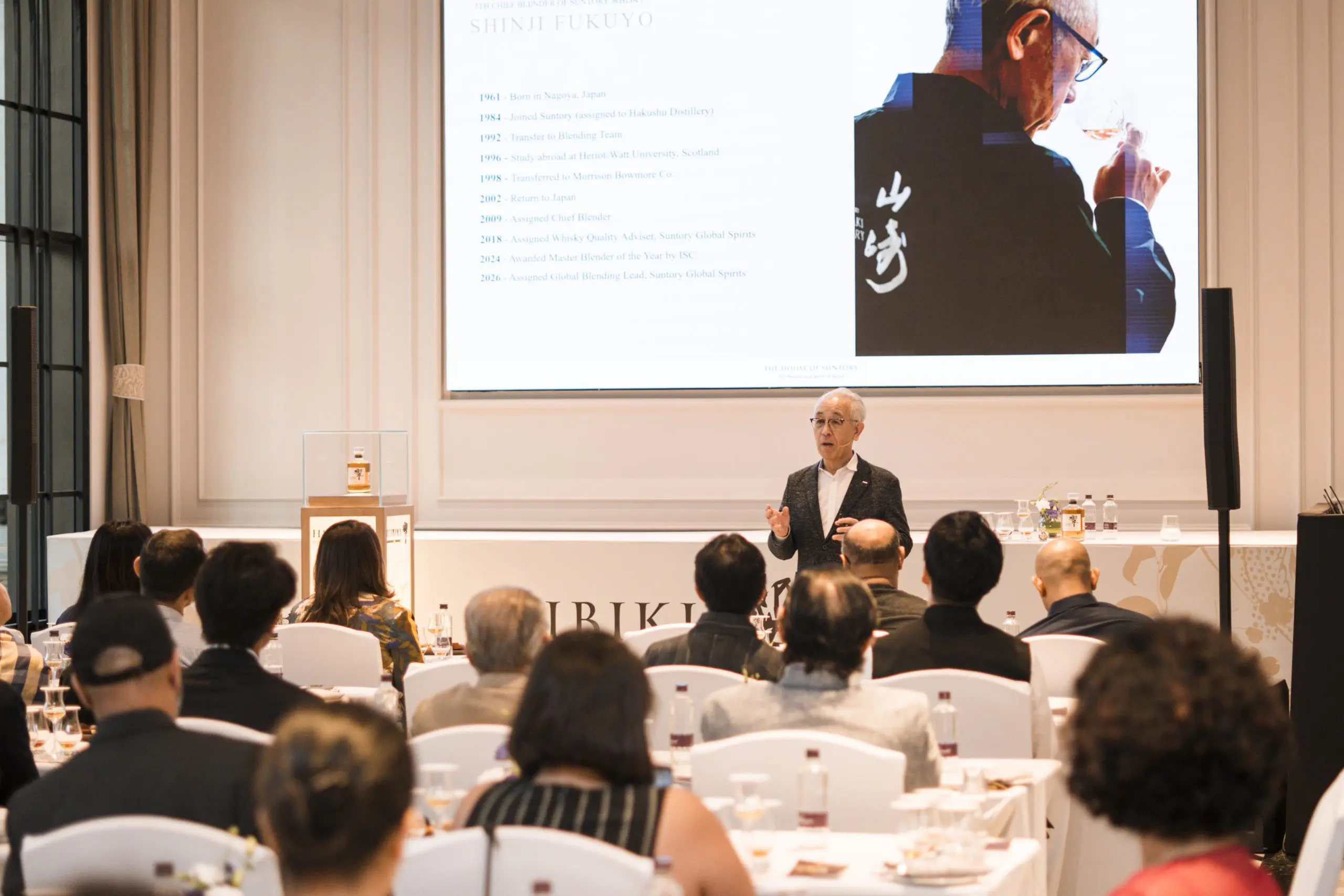
The landscape of Japan plays a quiet yet profound role in whisky making. Humid summers, crisp winters and dramatic seasonal changes influence how whisky matures in its casks. Vegetation surrounding the distilleries, temperature fluctuations and humidity all shape the character that slowly develops within the barrel.
These natural rhythms explain why Japanese aesthetics often favour simplicity. In architecture and design, palaces in Japan tend to emphasise space and restraint rather than ornate excess. The same philosophy carries into whisky making where the result is a spirit that feels composed rather than forceful.
We learn that technique cannot alone create the sophistication and desired complexity. Time and nature must do their work. Distillation can create precision, but maturation creates character.
Over time, aromas evolve into layers that even experienced noses struggle to define. Some resemble fruits (like starfruit) unfamiliar to many drinkers, making them difficult to identify without years of tasting experience.
“A good nose and palate are important tools for a blender, but they are only the beginning”, he says. Training, patience and decades of sensory learning are what ultimately shape mastery.
While Scotch whisky and bourbon often lean toward bold, assertive flavours, Japanese whisky has developed a reputation for elegance. The aromas tend to be clean and transparent, often floral, while the palate remains rounded and approachable. Rather than overwhelming the drinker, the whisky invites contemplation. Sophistication, thus lies in its balance.
Crafting the Spirit
The creation of a bottle begins long before blending. Malted barley, yeast and water are carefully selected to ensure quality at the very first stage of production.
Fermentation, distillation and maturation follow, each requiring meticulous attention. Wooden casks gradually shape flavour over years of ageing, while blenders monitor the developing spirit. Even after the whisky is ready, precision remains paramount. Labels must be perfectly aligned, packaging carefully wrapped and pricing correctly positioned within the market and calligraphy, of course! Luxury, after all, is as much about presentation as it is about flavour.
Kaizen in the Whisky World
At the heart of Japanese craftsmanship lies the concept of ‘continuous improvement’.
In whisky making, this philosophy manifests through two ideas: consistency and efficiency. “Maintaining quality while improving productivity ensures that the spirit remains reliable without compromising its character”, he says. Each cycle of production becomes an opportunity to refine the process further (to think that this serves as a great metaphor to life would be ardent).
The Ritual of Ice
Japanese whisky culture extends beyond the bottle to the way the spirit is served. Bartenders often carve large blocks of ice into perfectly smooth spheres. These slowly melting orbs dilute the whisky gently, preserving its balance while gradually lowering the alcohol strength.
Whilst speaking with Shinji Fukuyo, I discovered something unexpectedly fascinating about Japanese whisky culture: the reverence for ice is almost as meticulous as the craft of the whisky itself.
“The spherical shape also reduces the surface area in contact with the liquid, allowing the drink to remain cooler for longer without excessive dilution.”
Beyond function, the ice performs a quiet act of theatre slender, crystal clear rods-(often referred to as Ninja Ice) carved with such precision they appear almost invisible in the glass, like a secret structure supporting the drink without ever revealing itself.
What are we to feel?
When asked what emotion a drinker should feel, Shinji Fukuyo pauses before answering with striking simplicity. When he drinks Hibiki, he says, he becomes a little more present. The remark is telling; Japanese whisky, he explains, is meant to be contemplated.
One should first pay attention to the liquid, its aroma, its balance, it’s quiet complexity before anything else. Conversation may follow, television may play in the background, but the moment begins with reflection. “When you drink whisky,” he says, “you think about the whisky itself.”
You may also read: In Conversation with Pranav Saboo on Jacob & Co.’s flagship debut in Delhi