Wearing India on the wrist: Gaurav Mehta debuts inaugural haute horlogerie collection
- Featured Retail
 Yashita Damani
- 15 minutes read

I genuinely don’t think there could’ve been a better way to experience Jaipur than this (no matter how many time you have been before). Known as the Pink City, Jaipur is where royal grandeur meets centuries of craftsmanship and culture. Every palace, gateway and bustling bazaar tells a story, and this trip was designed to immerse us in exactly that (and help us better understand the inspiration behind the dials and the depth of every gate).
Our stay began at the iconic Rambagh Palace, once home to Jaipur’s royal family. After lunch at The Botanist, we wandered through the breathtaking Pritam Chowk, where each of the four intricately painted gates represents a different season. As evening fell, we gathered inside the magnificent Suvarna Mahal for the unveiling of Gaurav Mehta’s Gates of India collection. Inspired by India’s historic gateways, the collection beautifully transforms architectural heritage into wearable art, making for an unforgettable evening over a chef-curated dinner.
This wasn’t just a luxury getaway or just another watch launch, it was an invitation to experience Jaipur’s stories, its craftsmanship, and the timeless heritage that continues to define this extraordinary city. And honestly, I left seeing Jaipur in a completely different light.

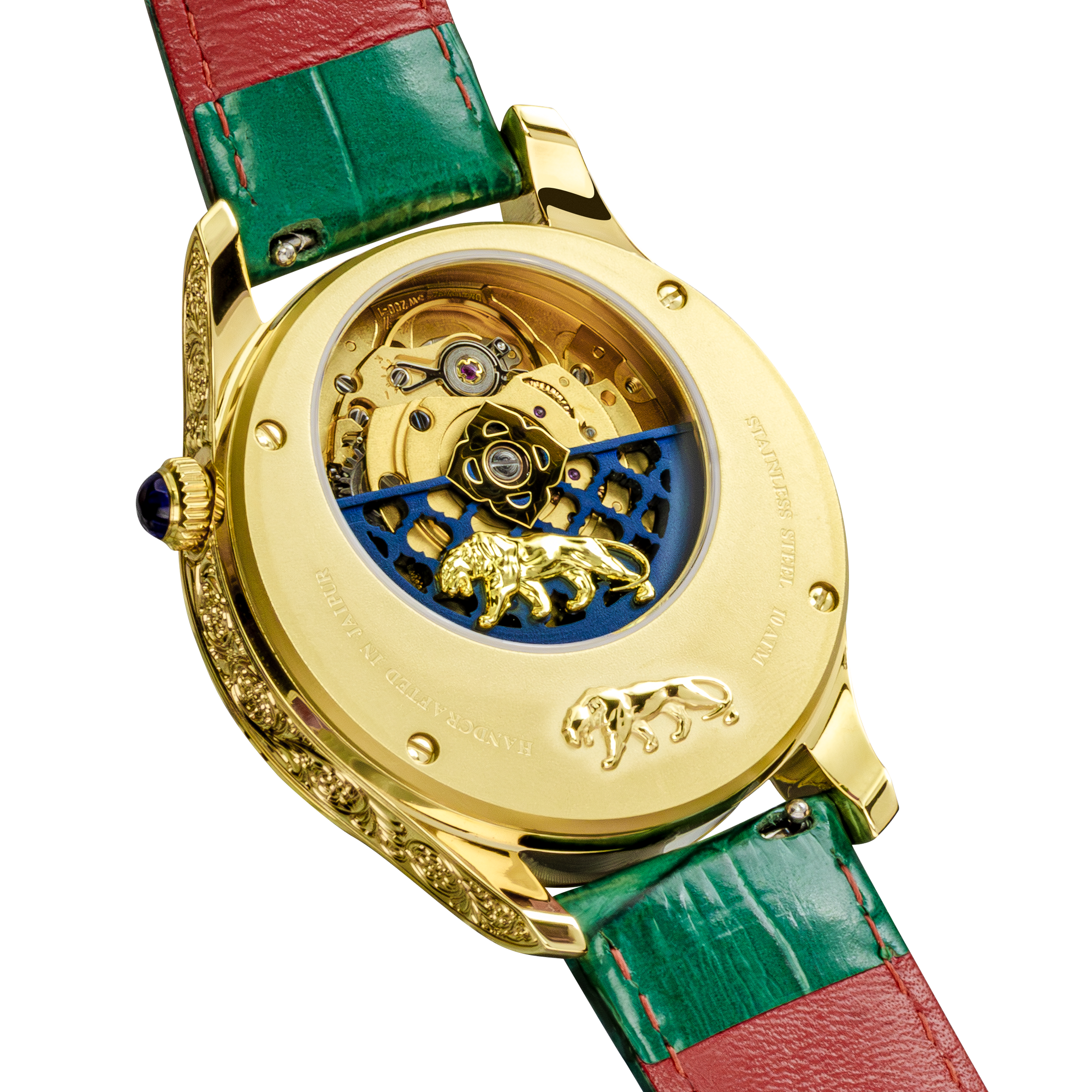
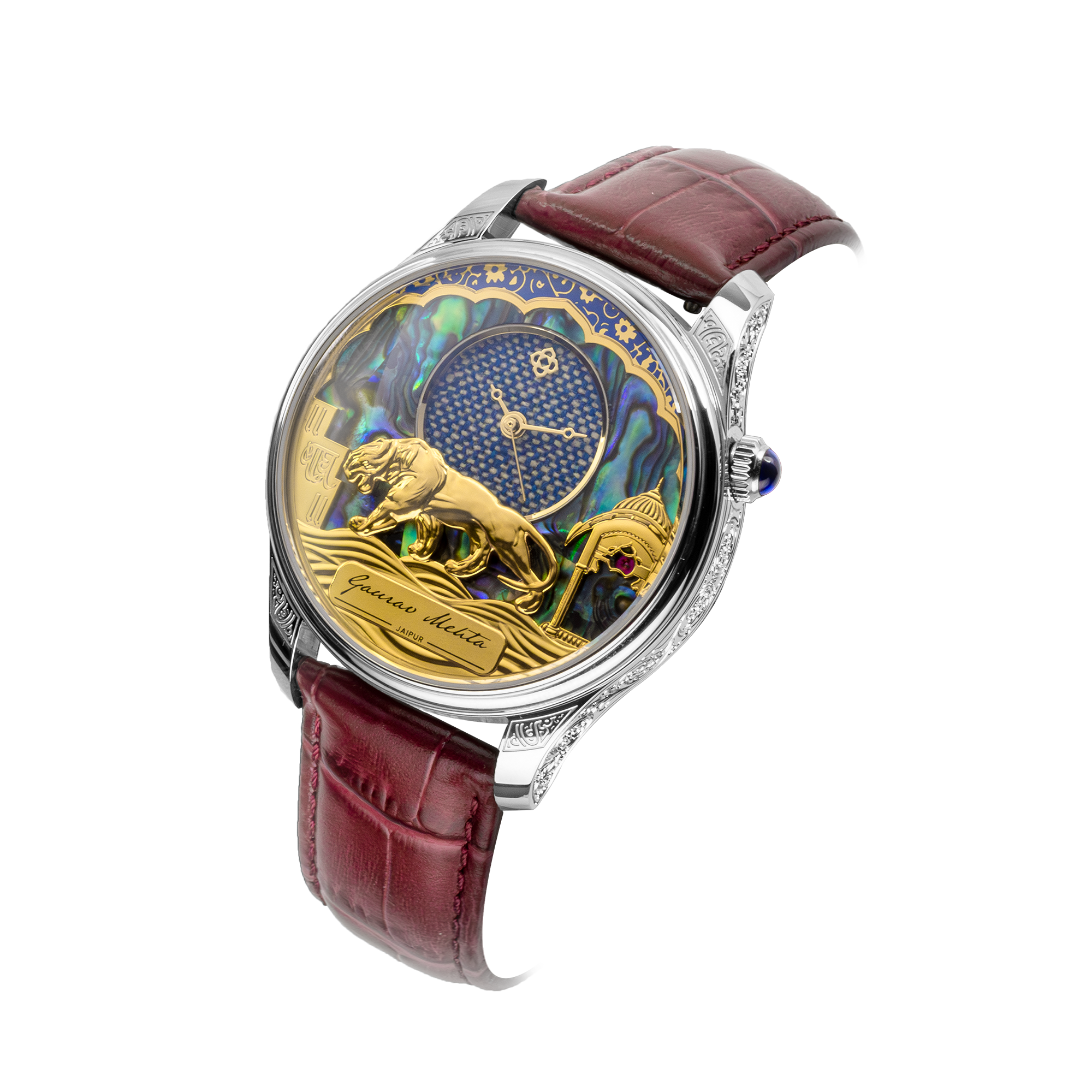
The Premium Baagh Collection draws inspiration from Rajasthan’s royal legacy. At its centre sits a sculpted golden tiger traversing a desert landscape, representing strength and sovereignty. The dial combines turquoise stone mosaic with an off-centre time display wrapped in pink muslin khadi, while a ruby set chhatri and intricate filigree details complete the composition. Housed in a CNC milled 316L stainless steel case with turquoise stone inlays, the watch is powered by the Swiss made Sellita SW200 automatic movement, visible through an exhibition caseback engraved with a tiger motif.

The second launch, the Gates of India Collection, takes cues from the iconic Lotus Gate and Leheriya Gate of Jaipur’s City Palace. Its defining feature is a flip mechanism that reveals miniature depictions of some of India’s best known landmarks, including the Gateway of India, India Gate, the Red Fort and Charminar, transforming the watch into an interactive celebration of the country’s architectural legacy.

Speaking about the launch, Gaurav Mehta, Founder and Designer of Jaipur Watch Company, said, “With the Gaurav Mehta Collection, my endeavour was to create heirloom timepieces that serve as true custodians of India’s magnificent heritage and architectural pride. These creations unite royal Indian storytelling with fine mechanical engineering for discerning collectors worldwide.”
With this launch, Jaipur Watch Company expands its portfolio of heritage driven watches while positioning the new Gaurav Mehta Collection as a statement in Indian luxury watchmaking, where traditional artistry meets contemporary mechanical craftsmanship.
In Conversation with Gaurav Mehta, Founder and CEO of Jaipur Watch Company
LuxeBook: Why was CNC engraving the right choice for bringing India’s architectural gateways to life on a watch dial?
Gaurav Mehta: When you are recreating iconic, centuries-old stone structures, you are dealing with sharp geometric symmetry, intricate archways, and minute structural details that must remain crisp even at a microscopic scale. CNC engraving was the right choice because it provides absolute micro-mechanical repeatability and extreme structural depth that hand-carving alone cannot consistently achieve across ultra-thin metal plates. A watch dial is a merciless canvas; even a fraction of a millimeter of drift can warp the perspective of an archway or blur a delicate lattice detail. By utilizing advanced multi-axis CNC technology, we were able to carve deep, sharp three-dimensional reliefs into the metal, giving structures like the Gateway of India or Charminar the crisp geometric integrity and architectural presence they deserve.
LuxeBook: How do you translate something as monumental as a palace gate into a surface that’s only a few centimetres wide?
Gaurav Mehta: Translating a towering 100-foot stone monument onto a canvas measuring under 35 millimeters requires a complete rethink of spatial design. You cannot simply take a photo or blueprint and shrink it down, because micro-scale surfaces absorb light differently and lose depth. We had to study how light hits the arches and pillars of structures like the Lotus Gate or India Gate, selectively emphasizing key architectural lines while simplifying background elements. By manipulating relief depth—carving foreground arches slightly deeper and keeping background lattices shallower—we created an optical illusion of grand spatial perspective within a space no thicker than a coin.
LuxeBook: How much of the final look comes from machine precision versus hand finishing?
Gaurav Mehta: It is an equal marriage of high-tech engineering and soul. Machine precision gives us the structural skeleton—the clean 3D geometry, exact proportions, and crisp mechanical tolerances necessary for the flip mechanism and micro-carvings. However, a raw CNC-milled dial lacks warmth; it can look cold and sterile. Every single engraved component undergoes rigorous hand-finishing, where our master artisans apply delicate satin brushing, hand-polished chamfers, and microscopic textural touch-ups. The machine provides the mathematical accuracy, but the human hand gives the dial its depth, soul, and luxurious reflection of light.
LuxeBook: Which gateway was the most technically challenging to engrave, and why?
Gaurav Mehta: The Charminar was undoubtedly the most technically demanding structure to translate onto the dial. Unlike single-arch monuments, the Charminar features four massive, towering minarets surrounding a complex multi-tiered central structure with intricate jaali (lattice) work and delicate balcony arches. Programming the tool paths to carve four slender, freestanding vertical pillars without compromising the micro-structural integrity of the metal or creating burrs was a nightmare. Achieving the correct shadow depth inside the central arch while keeping the outer minarets sharply defined took months of trial and micro-machining adjustments.
LuxeBook: Were there details that had to be sacrificed because of the limitations of the process?
Gaurav Mehta: Yes, micro-engineering forces you to make tough artistic compromises. When working on a scale measured in microns, certain ultra-fine carvings—like microscopic stone textures or intricate calligraphy carved into historical walls—have to be subtly adapted. If you try to force every micro-line onto a tiny metal plate, the cutting tools can cause metal burrs, or the details simply merge together under normal viewing light. Instead of sacrificing quality, we artistically translated those hyper-dense patterns into cleaner, stylized relief lines that capture the essence and grandeur of the original masonry without creating visual clutter.
LuxeBook: What level of precision are you working with when engraving these dials?
Gaurav Mehta: We operate at tolerances measured down to single microns—often working within a precision range of 0.005 to 0.01 millimeters. To put that into perspective, a human hair is roughly 0.07 millimeters thick, so our cutting bits are operating at a fraction of that width. When you are carving dynamic 3D architecture into an ultra-thin dial plate that must also clear internal mechanical hands and sapphire crystal clearances, even a 5-micron error can cause a mechanical jam or ruin the visual symmetry. Every pass of the cutter is calculated down to the microscopic level.
LuxeBook: How many iterations did it take before you achieved the depth and texture you envisioned?
Gaurav Mehta: It took over fifteen distinct prototype iterations for each gateway before we felt we had captured the true essence of the architecture. In the early samples, the reliefs either looked too flat, like a simple stamped coin, or were carved too deeply, which added unwanted thickness to the watch case and interfered with the flip mechanism. We spent months tweaking cutter angles, playing with shadow depths, and testing different hand-finishing techniques until we hit that perfect harmony where the light catches the monument’s arches with natural, three-dimensional grandeur.
LuxeBook: What surprised you most about what CNC technology can achieve today?
Gaurav Mehta: What surprised me most was the sheer fluidity and delicacy that modern multi-axis CNC machines can achieve when pushed beyond standard industrial uses. Watchmakers traditionally view CNC machinery as a tool for creating functional case blanks or movement bridges. Seeing a micro-milling cutter move with the delicate grace of a sculptor’s chisel—carving organic curves, microscopic lattice patterns, and sweeping architectural domes into solid steel with micron-level consistency—completely redefined my perception of how technology can serve fine art.
LuxeBook: How does digital printing help recreate the colours and intricate motifs of India’s historic gateways?
Gaurav Mehta: Digital printing allows us to introduce rich, microscopic color accuracy over complex three-dimensional relief surfaces where traditional enamel or hand-painting would pool or lose detail. Historic gateways like the Lotus or Leheriya Gates at City Palace are celebrated for their vibrant, flowing color palettes and intricate floral patterns. Modern high-resolution digital printing allows us to lay down ultra-fine, microscopic droplets of pigment with pinpoint precision, capturing smooth color gradients and subtle artistic motifs directly over the contoured metal surfaces without obscuring the underlying engraving.
LuxeBook: How do you ensure the printed colours remain vibrant over time without compromising luxury?
Gaurav Mehta: We use specialized, archival-grade UV-cured pigments that are engineered to withstand decades of light exposure without fading, yellowing, or cracking. Once the digital printing process is complete, the dial components undergo a delicate sealing process using microscopic protective clear coats. This preserves the vivid color saturation—whether it’s the rich pinks of Rajasthan or deep turquoise hues—while sealing the artwork beneath a scratch-resistant, anti-reflective sapphire crystal, ensuring the watch maintains its museum-quality brilliance for generations.
LuxeBook: Was colour accuracy one of the biggest challenges in this collection?
Gaurav Mehta: Color accuracy was an absolute obsession for us throughout development. Recreating iconic shades—like the specific royal pink of Jaipur’s Muslin Khadi or the vibrant hues of the City Palace gates—on metal surfaces is extraordinarily tricky because metal reflects light differently than fabric or stone. A shade that looks perfect on paper can appear muted or washed out once printed on a reflective, textured dial. We ran dozens of color trial runs, constantly adjusting pigment density and lighting angles to ensure the colors evoke the exact warmth and royal heritage of the original inspirations.
LuxeBook: Can collectors actually see the layering between the engraving and the printed elements?
Gaurav Mehta: Absolutely, and that three-dimensional layering is where the real visual magic happens. When you look at the dial under natural light, you see the crisp, structural shadows cast by the deep CNC-milled metal reliefs, while the printed colors and motifs float smoothly across those contours. This creates a mesmerizing sense of depth—the light catches the metallic edges of the micro-architecture first, and as your eye moves deeper into the dial, the rich printed colors bring the artwork to life. It feels like looking into a miniature, illuminated architectural model.
LuxeBook: Which comes first, the engraving or the printing, and why does the sequence matter?
Gaurav Mehta: The engraving always comes first, and the sequence is absolutely vital to the success of the piece. Engraving establishes the physical 3D topography of the dial—the arches, pillars, and background walls. If you were to print first and then attempt to carve into the metal, the high-speed milling tools would instantly tear, burn, or strip away the delicate printed pigment along the cut edges. By completing all the CNC carving, deburring, and metal hand-finishing first, we create a pristine, textured canvas ready to receive the microscopic alignment of the printed color layers.
LuxeBook: What’s one detail on the dial most people will never notice, but you hope they do?
Gaurav Mehta: On the Premium Baagh, it is the subtle, courtly filigree elements and the delicate way the miniature ruby is set within the 3D Rajput Chhatri. On the Gates of India, it is the microscopic lattice (jaali) work carved into the recessed windows of the monuments. Most people will admire the grand arches or the flip action, but if you look closely under a loupe, you will notice that even the tiniest background windows have genuine physical depth and individual structural cutouts. It is a quiet homage to the unsung stone artisans who carved India’s real palaces centuries ago.
LuxeBook: When you first held the finished watch, what was the one thing that made you think, we got it right?
Gaurav Mehta: It was the tactile weight and the crisp, mechanical click of the flip mechanism in action. We had spent so many months looking at 3D CAD renders and raw metal components on workshop benches, but the moment I held the fully assembled piece at Rambagh Palace, flipped the case, and felt that solid, perfectly balanced detent engage—revealing the sculpted monument beneath the sapphire glass—I knew we had nailed it. It didn’t just look like a luxury watch; it felt like holding a piece of living history in the palm of your hand.
LuxeBook: Do you see yourself as a watchmaker, an engineer, or a storyteller?
Gaurav Mehta: At my core, I see myself first and foremost as a storyteller. Watchmaking and engineering are the refined languages and tools I use to tell those stories, but the ultimate purpose of everything we build at Jaipur Watch Company is narrative. Anyone can build a precise machine that tells the time, but creating something that evokes pride, captures the sovereign beauty of Rajasthan, or preserves the architectural majesty of India on your wrist—that requires storytelling. The gears, CNC machines, and Swiss movements are simply the ink we use to write India’s story for the world.
You may also read: India’s most beautiful palace-turned hotels